



Thinking you need a gym membership and fancy equipment to get fit is one of the biggest myths out there. The truth is, you can build an incredibly effective beginner home workout routine with nothing more than your own body weight and a little bit of floor space. We're talking about foundational movements that build real strength, boost your endurance, and help you create a fitness habit that actually sticks—all from your living room.
Why Home Workouts Are Here to Stay
Working out at home has gone from a temporary fix during lockdowns to a permanent lifestyle choice for millions. It’s not just a passing trend; it’s a real shift in how we think about fitness. People are choosing accessibility, comfort, and consistency over the traditional gym scene, and for good reason.
Let's be honest, for most of us, the biggest hurdle to working out isn't a lack of motivation—it's the logistics. The commute to the gym, waiting for machines, and those monthly fees can feel like too much. A home workout completely removes those roadblocks. Your "gym" is always open, ready for a quick 20-minute session before your first meeting or a longer sweat session on a Saturday.
The Rise of At-Home Fitness
The numbers don't lie. We saw a huge jump in people exercising at home, going from 24% in 2019 to a high of 36% in 2021. And while things have settled, that preference is holding strong. A 2023 survey found that 51% of U.S. exercisers now prefer working out at home, proving this is a lasting change. If you're curious, you can read more about the home fitness industry surge and find additional statistics.
This boom has also created an amazing support system. You're not just left to guess what to do. There's a ton of high-quality guidance just a click away:
- Fitness Apps: These are perfect for structured programs, tracking your progress, and following guided sessions.
- Online Videos: YouTube is a goldmine of follow-along routines from certified trainers for every fitness level.
- Supportive Communities: Joining online groups or forums can be a huge boost for encouragement and accountability.
The real magic of working out at home is how sustainable it is. When you get rid of the common excuses—time, cost, and feeling self-conscious—you set yourself up for consistency. It’s about making fitness fit into your life, not the other way around.
Key Benefits of a Beginner Home Workout Routine
Starting your fitness journey at home is an empowering move. It gives you the space to learn the basics at your own speed, without feeling like anyone is watching. You build confidence with every single rep, creating a solid foundation for a healthier, more active life. This isn't just about convenience; it's about building a personal and sustainable path to your goals.
Setting the Stage: Your Space and Your Mindset
Before you even think about your first squat, let's talk about setting yourself up for success. Honestly, the biggest hurdle for most people isn't the workout itself—it's just starting. Creating a dedicated space and getting your head in the game can make all the difference.
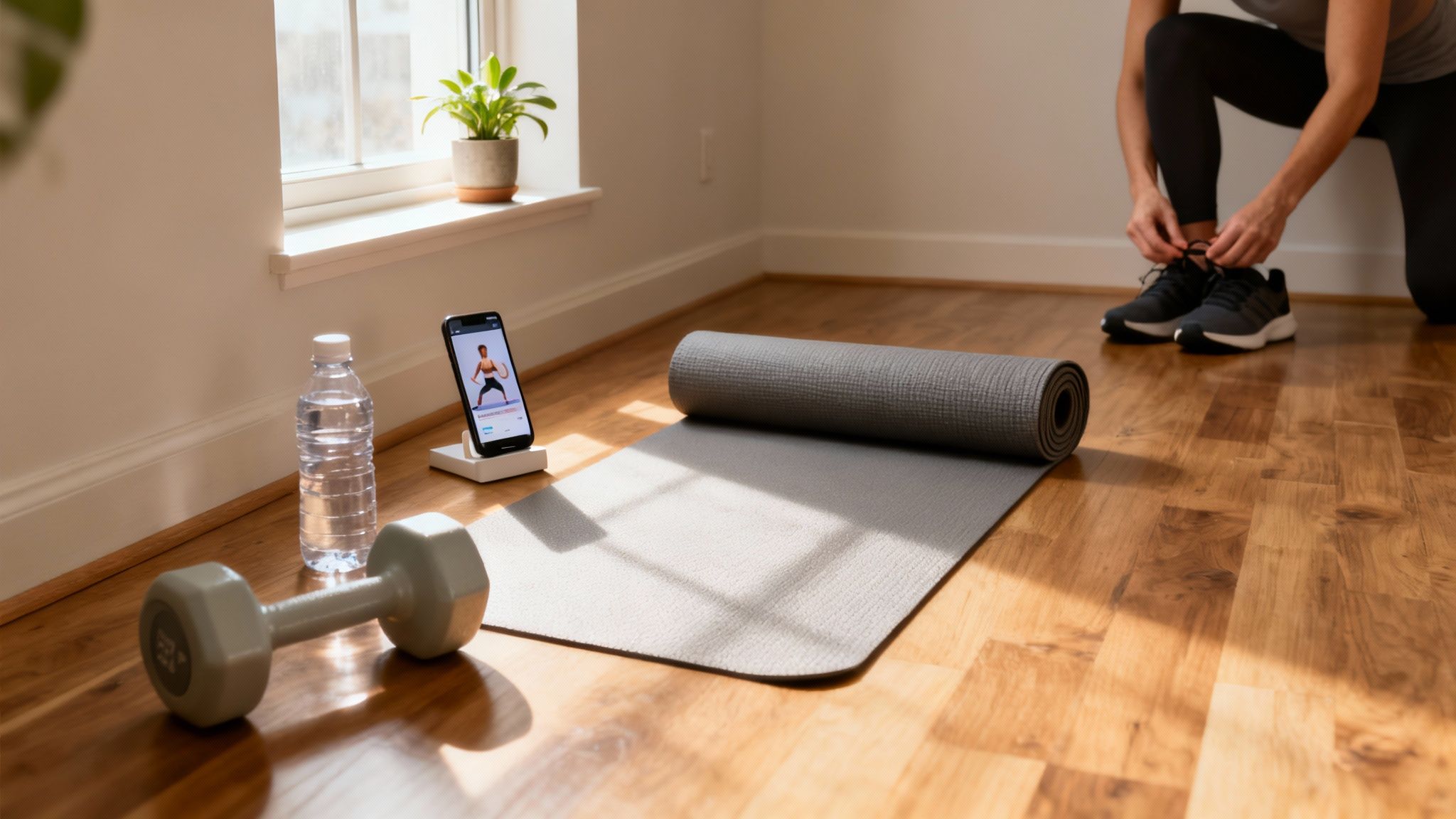
This isn't about building a full-blown home gym. Forget that. All you need is a corner of a room that you can claim as your own. When you step into that spot, your brain gets the signal: it's time to move.
Carving Out Your Workout Corner
Making your space functional is surprisingly simple. The whole point is to remove any and all excuses that might pop up when it's time to train.
Here’s what you actually need to get started:
- A Clear Six-Foot-Square Area: You just need enough room to lunge or stretch out for a plank without kicking the coffee table.
- An Exercise Mat: A simple yoga mat does the trick. It cushions your joints and visually marks your territory.
- Your Workout Plan: Have it ready to go. Keep it on your phone, a tablet, or even a printed piece of paper so you’re not scrambling to remember what’s next.
- A Water Bottle: Hydration is key. Keep water within arm's reach.
When these items live in your workout corner, ready and waiting, you’ve just eliminated half the battle. Your mat is already there, practically calling your name.
Getting Your Head in the Game
Your physical space is set, but what about your mental space? This is just as crucial. The conversation you have with yourself can either build you up or tear you down.
Try this little mental flip: Instead of thinking, "I have to work out," tell yourself, "I get to move my body." It transforms exercise from a chore into an opportunity for self-care.
Focus on just showing up. Consistency beats intensity every single time, especially when you're starting out. Only had time for 10 minutes? Great. That's a win. This approach builds momentum and helps you avoid the all-or-nothing trap that trips up so many people.
It’s this convenience and consistency that makes working out at home so effective. One poll found that 52% of U.S. adults exercise regularly at home, a figure that dwarfs the 28% who stick with a gym membership. It just goes to show that the easier you make it to start, the more likely you are to stick with it. You can discover more insights about home fitness habits and see why it works for so many.
The 5-Minute Warm-Up That Will Actually Prevent Injury
Let's be honest, it's tempting to jump straight into the main event. But diving into a workout cold is one of the fastest ways to get sidelined with a pulled muscle or a nagging strain. Think of your warm-up as the essential prep work—it's what tells your body and mind, "Okay, we're about to move."
This isn't just about getting in the zone, though. A good warm-up literally warms you up. It gradually gets your heart rate up, sending more oxygenated blood to your muscles. This increases their temperature, making them more elastic and far less likely to tear.
It’s the difference between trying to stretch a cold rubber band and a warm one. You know which one is going to snap.
Dynamic Moves Beat Old-School Static Stretches
For years, we were told to hold stretches for 30 seconds before exercising. We now know better. Before a workout, you want to prepare your body for action, and that calls for a dynamic warm-up—active movements that take your joints through their full range of motion.
Here’s a simple, effective 5-minute routine I use with all my clients just starting out. Do this before every single workout.
- Torso Twists (30 seconds): Stand with your feet about shoulder-width apart and gently rotate your upper body left and right. This is great for waking up your core and getting some mobility in your spine.
- Arm Circles (30 seconds each way): Make circles with your arms—start small and get progressively bigger. Go forward for 30 seconds, then reverse it. This gets the shoulder joints ready for action.
- Leg Swings (30 seconds per leg): Find a wall or sturdy chair for balance. Swing one leg forward and back, then side to side. This is crucial for opening up the hips, which are tight on most of us.
The goal here isn't to get tired; it's to feel energized. You should finish feeling warmer, maybe a little out of breath, and ready to attack the main workout with focus and solid form.
For the last two minutes, I always recommend doing "priming" reps. These are just lighter, slower versions of the actual exercises you're about to do. If you have squats in your workout, do a few shallow bodyweight squats. If you have push-ups, do a few against the wall. This preps those exact movement patterns, making your first real set feel much smoother and safer.
Your Foundational No-Equipment Full Body Circuit
Alright, you're warmed up and ready to go. This is where the real work begins. We're going to dive into a simple but incredibly effective circuit that uses nothing but your own body weight.
The idea behind a circuit is to move from one exercise to the next with very little rest in between. This approach is a game-changer because it builds muscle and gets your heart rate up at the same time—a seriously efficient way to train.
Your goal isn’t to push yourself to exhaustion. It's about showing up consistently and feeling challenged, not defeated. Every single rep you do with good form is a win.
Mastering The Movements
Before we jump in, let's talk about form. This is non-negotiable. Moving slowly and with intention is always better than blasting through a bunch of sloppy reps. When you focus on control, you engage the right muscles and dramatically lower your risk of getting hurt.
Here's a quick visual reminder of the dynamic warm-up movements that get your body prepped for the circuit.
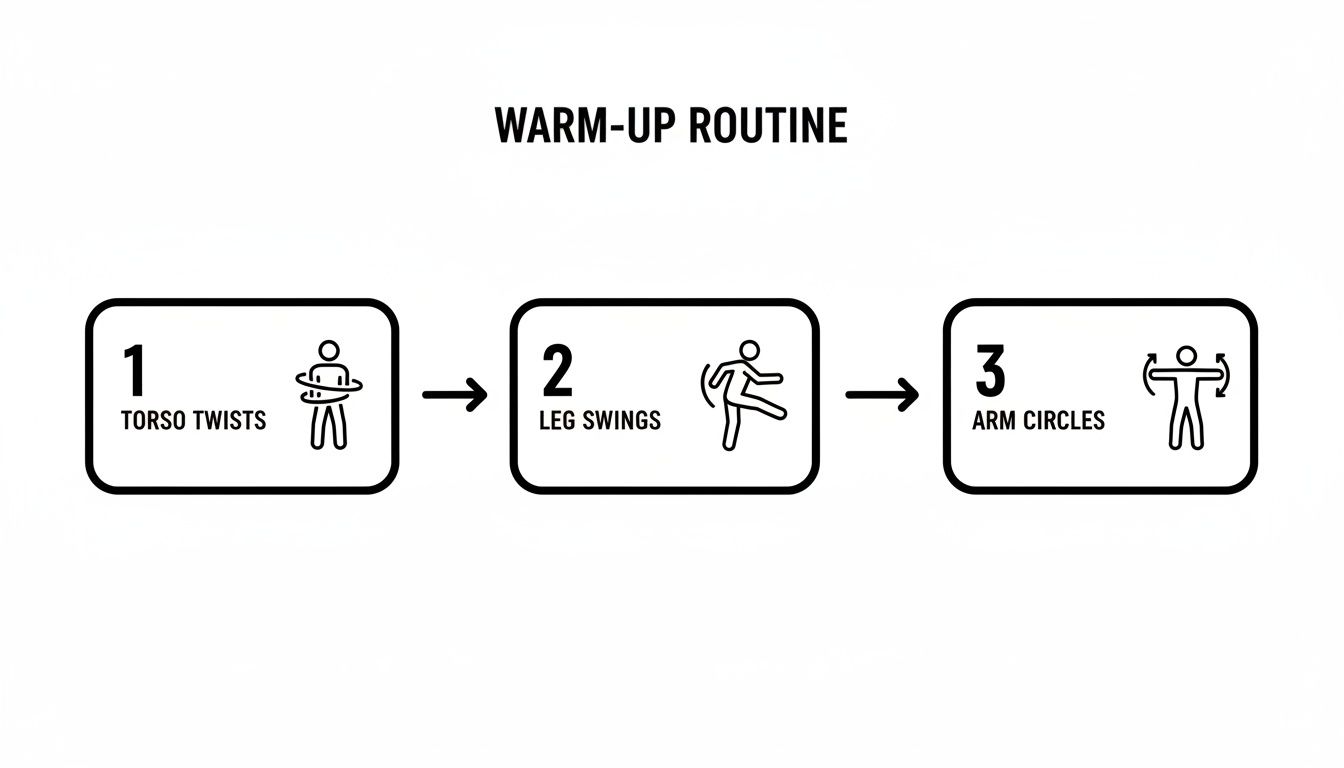
This flow primes all the major joints and muscle groups we’re about to put to work.
Below is the complete circuit we’ll be using. It’s designed to hit every major muscle group for a true full-body workout.
Beginner Full-Body Workout Routine
This is a circuit of 6 foundational exercises. Complete all exercises in order to finish one round. Rest for 60-90 seconds, then repeat for a total of 2-3 rounds.
| Exercise | Target Muscles | Sets x Reps | Key Form Tip |
|---|---|---|---|
| Bodyweight Squats | Glutes, Quads, Hamstrings | 2-3 x 10-15 | Keep your chest up and drive through your heels. |
| Incline Push-Ups | Chest, Shoulders, Triceps | 2-3 x 8-12 | Maintain a straight line from your head to your heels. |
| Glute Bridges | Glutes, Hamstrings | 2-3 x 12-15 | Squeeze your glutes at the top of the movement. |
| Plank | Core, Shoulders | 2-3 x 20-30s Hold | Don't let your hips sag; keep your core tight. |
| Bird-Dog | Core, Glutes, Lower Back | 2-3 x 10 per side | Move slowly and avoid arching your back. |
| Jumping Jacks | Full Body (Cardio) | 2-3 x 30 seconds | Land softly on the balls of your feet. |
Remember to focus on quality over quantity for every single rep.
My Go-To Tip for Beginners: Think about "time under tension." For exercises like squats and push-ups, try a 2-1-2 tempo. That means taking 2 seconds to lower down, pausing for 1 full second at the bottom, and taking 2 seconds to push back up. This control builds strength far more effectively than just going fast.
How To Put It All Together
So, what does this look like in practice? You’ll perform each of the 6 exercises back-to-back, following the recommended reps or time.
- Do 10-15 Bodyweight Squats.
- Move right into 8-12 Incline Push-Ups.
- Then 12-15 Glute Bridges.
- And so on, until you finish the 30 seconds of Jumping Jacks.
That whole sequence is one round. Once you've completed it, take a breather for 60-90 seconds. Grab some water, catch your breath, and then get ready to go again. As a beginner, your target is to complete 2-3 full rounds.
And don't forget, what you do after your workout matters just as much. Fueling your body properly is key to recovery and getting stronger. For some great ideas, check out our guide on the best post-workout recovery foods to help you make the most of your efforts.
How to Build a Consistent Weekly Workout Schedule
The best workout routine in the world is useless if you don't actually do it. This is where so many people trip up. The secret isn't finding some magic set of exercises; it's building a schedule that fits into your real life, not some fantasy version of it. Let's make this beginner routine a seamless part of your week, not just another thing on your to-do list.
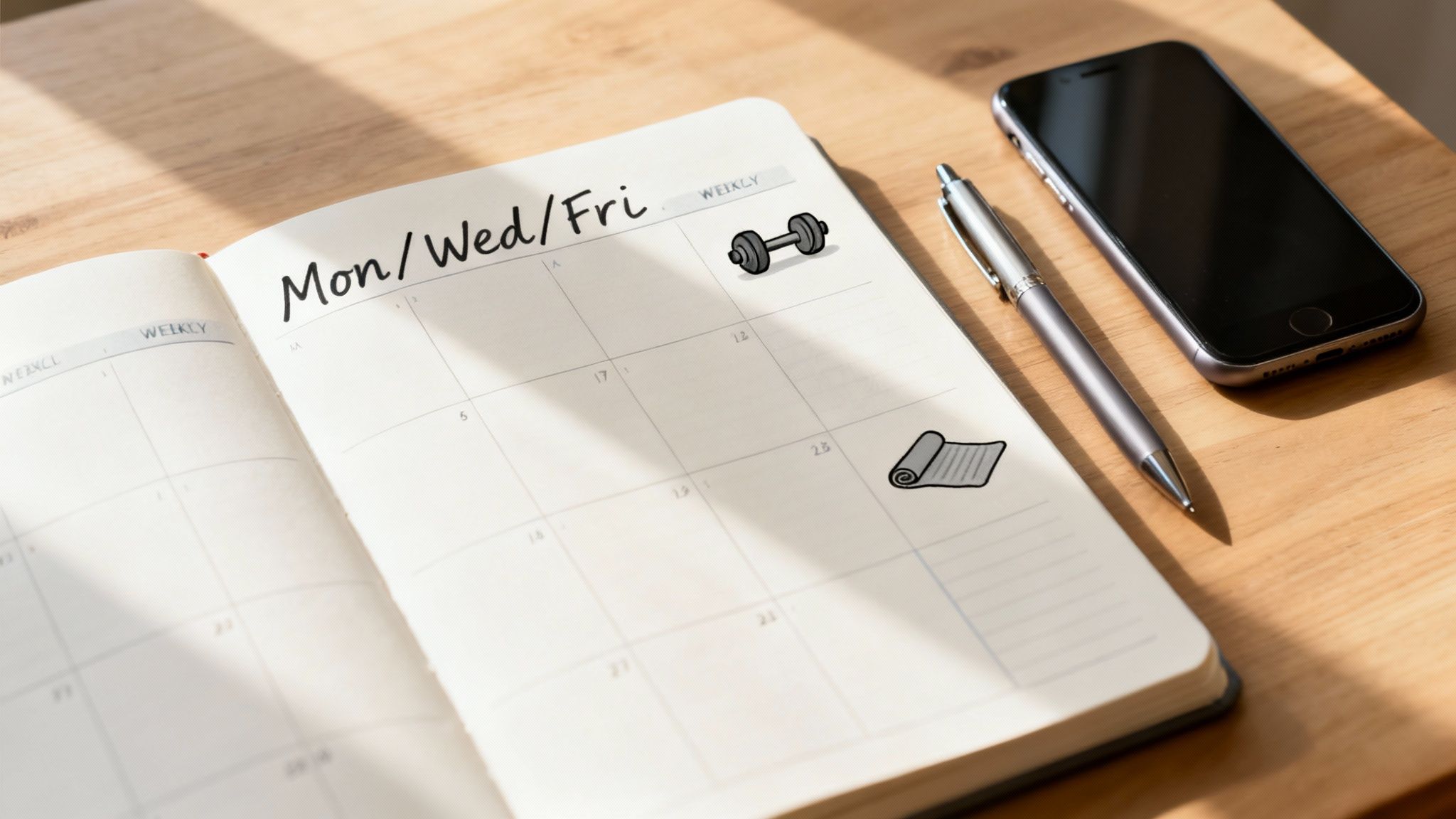
First, let go of the "all or nothing" mindset. Some weeks, you'll feel energized and hit three workouts without a problem. Other weeks, just getting two done will feel like a win. Guess what? They both are. The real goal here is to create a habit that can bend without breaking.
Finding Your Weekly Rhythm
To get you started, I've mapped out two of the most common and effective weekly splits for beginners. Take a hard look at your calendar and be honest about which one feels more doable right now. You can always change it later.
Here are a couple of solid options to kick things off.
Sample Weekly Workout Schedules
| Day | Option 1 (Steady Progress) | Option 2 (Time-Crunched) |
|---|---|---|
| Monday | Workout | Rest |
| Tuesday | Rest | Workout |
| Wednesday | Workout | Rest |
| Thursday | Rest | Rest |
| Friday | Workout | Workout |
| Saturday | Active Recovery (Walk/Yoga) | Active Recovery (Walk/Yoga) |
| Sunday | Full Rest | Full Rest |
Whether you choose Option 1 for more frequent sessions or Option 2 to fit a packed schedule, the key is planning ahead. Deciding on Sunday which days you’ll work out makes it far more likely to happen.
The best schedule is the one you can stick with for more than a week. It’s far better to succeed at two workouts a week than to plan for five and do none. Consistency beats intensity every single time.
Why Rest Days Are Not Optional
It’s easy to fall into the trap of thinking that more is always better. But here’s a crucial piece of advice: your muscles don't get stronger during the workout. They get stronger during the rest periods in between.
Skipping rest days is one of the fastest ways to burn out, get injured, and completely derail your progress. These "off" days are an active, non-negotiable part of your training. This is when the magic happens and your body does its repair work.
You’ll probably also find that pairing this new habit with better nutrition really amps up your results. For some simple ideas, you might want to explore a clean eating meal plan to help fuel your workouts and recovery.
Ultimately, your body is your best coach. If you're feeling incredibly sore or drained, take an extra rest day. No guilt. If you're buzzing with energy, maybe go for a long walk on an off day. Learning to listen to these cues is a skill that will keep you in the game for the long run.
How to Progress When Your Workout Feels Too Easy
So, you've been sticking with it, and the workout that once left you winded now feels… well, kind of easy. First off, congratulations! That's a huge sign that you're getting stronger and fitter. When you can finish your last set feeling like you could do more, your body is telling you it's time to level up.
This is the point where a lot of people think they’ve hit a wall without a gym or heavy weights. But you can absolutely keep getting stronger right where you are. The secret is a principle called progressive overload, which is just a fancy way of saying you need to find ways to make your workouts a little harder over time. This is how you avoid getting stuck on a plateau.
Smart Ways to Increase the Difficulty
You don't need a brand-new routine. The best way to progress is by making small, deliberate changes to the workout you already know and do. It's about tweaking the dials, not reinventing the wheel.
Here are a few of my favorite methods for turning up the heat:
- Add More Reps or Sets: If you were doing 10 squats, try pushing for 12. Once that feels manageable, maybe go for 15. Another simple way is to add a whole extra round to your circuit. If you’ve been doing two, it’s time to tackle a third.
- Decrease Your Rest Time: This one is sneaky but effective. Try cutting your rest time between rounds by just 15 seconds. It doesn't sound like much, but it forces your heart and muscles to recover faster, giving your endurance a serious boost.
- Slow Down the Movement: Remember the "time under tension" tip? Let's exaggerate it. Try performing your squats or push-ups with a 4-2-4 tempo: four seconds to lower down, a two-second pause at the bottom, and four seconds to push back up. You’ll feel the burn in a whole new way.
The goal isn't to make the workout impossible; it's to make it challenging again. Just pick one of these to focus on for a few weeks. Once that feels like your new normal, you can introduce another small change.
Leveling Up Your Exercises
Another fantastic strategy is to simply swap an exercise you’ve mastered for a more challenging variation. This is where you really get to see your new strength in action.
For example, you could progress:
- From Bodyweight Squats to explosive Jump Squats
- From Incline Push-Ups to Knee Push-Ups or even Full Push-Ups
- From a standard Plank to a Plank with Shoulder Taps, which challenges your core stability
Down the road, you might want to think about adding some simple equipment. It’s a natural next step. In fact, after the pandemic pushed people toward home fitness, about 29% of U.S. exercisers bought their own gear. This shows a common progression from bodyweight-only workouts to using tools like resistance bands or a pair of dumbbells. You can discover more insights about the home fitness market and see just how popular this path has become.
Got Questions About Starting a Home Workout? Let's Clear a Few Things Up
It's completely normal to have a bunch of questions when you're just starting out. Diving into a new fitness plan can feel like there's a lot to learn, but a few straightforward answers can make all the difference.
Most beginners wonder about the same things: Do I need fancy equipment? How often should I be doing this? And what’s the deal with being sore afterward? Let's get those sorted.
Do I Need Any Special Equipment?
Honestly, no. You don't need a single piece of equipment to get started.
A really effective beginner home workout routine is built entirely on bodyweight exercises. The circuit we've laid out is designed to build that essential, foundational strength without anything but you and a bit of floor space. You'll see real progress, I promise.
How Often Should I Be Working Out?
When you're new to this, consistency is so much more important than intensity. Don't burn yourself out trying to do too much, too soon.
Aim for 2-3 workouts per week on days that aren't back-to-back. A Monday, Wednesday, and Friday schedule is a classic for a reason—it gives your body time to rest and recover. That recovery time is non-negotiable; it's when your muscles actually rebuild and get stronger.
What if I Feel Really Sore?
Feeling a bit tender a day or two after your workout is totally normal, especially at the beginning. This is just Delayed Onset Muscle Soreness (DOMS), and it's a good sign! It means your muscles are adapting to the new challenge.
Think of mild soreness as a badge of honor—it means you put in the work. However, if you feel any sharp or persistent pain, that's your body telling you to take an extra rest day. Gentle movement, like a short walk, can also do wonders for easing that stiffness.
If you want to dig deeper into building a solid foundation, our complete guide on how to start exercising walks you through everything you need to know to create a habit that actually sticks.
