


Starting a weight loss journey can feel like a huge mountain to climb, but what if the best gym for you is actually right inside your own home? This guide is built on a simple, powerful truth: the best home workout equipment for weight loss isn’t the fanciest or most expensive stuff—it’s the gear that actually fits your life. That means your space, your budget, and the kind of movement you genuinely enjoy.
We’re going to cut through the noise and give you a clear, actionable plan to get started.
Your Weight Loss Journey Starts at Home
Choosing to work out at home is about more than just convenience. It's about building a consistent habit in a space where you feel comfortable and confident, away from the crowds and pressure of a commercial gym. The real goal isn't to perfectly replicate a giant fitness center, but to create a personal setup that actually makes you want to move.
Success all comes down to picking tools you’ll use day in and day out. Think of this guide as your personal roadmap to building a home gym that doesn't just collect dust—it delivers real, lasting results.
What to Expect from This Guide
We're going to walk through the essential types of home fitness gear, breaking down exactly how each piece helps you reach your weight loss goals. You'll get a solid understanding of:
- High-Energy Cardio Machines: These are the calorie-burning powerhouses of any home gym. We’ll look at the equipment designed for those heart-pumping workouts that are fantastic for shedding fat.
- Versatile Strength Tools: From classic dumbbells to simple resistance bands, this is the gear that builds muscle. And more muscle means a faster metabolism, helping your body burn calories around the clock.
- Budget-Friendly Accessories: You absolutely don't need to spend a fortune to get fit. We'll show you some powerful, low-cost tools that deliver incredible results and barely take up any room.
The most effective workout plan is the one you actually stick with. Choosing equipment you enjoy using is way more important than buying the most high-tech machine on the market. Consistency is what truly drives change.
Our whole approach here is to give you the why behind the what. Instead of just throwing a list of products at you, we'll explain the science and strategy so you can make smart decisions for your own body and goals. By the end, you'll know exactly what you need to build the perfect setup for your transformation.
If you're eager to get moving right away, you might want to check out this beginner home workout routine that requires very little equipment to get you started on the right foot.
Cardio Machines: The Engines of Your Home Gym
When most people think about serious home workout equipment, cardio machines are usually the first things that pop into their heads. And for good reason. These are the workhorses of any home gym, designed to do one thing exceptionally well: get your heart rate up and keep it there. Think of them as the engine that drives your calorie burn.
But not all engines are built the same. Each machine offers a different path to your weight loss goals, catering to various fitness levels, personal preferences, and even how your joints feel on a given day. Getting to know how each one works is the first step in picking the right machine to power your fitness journey.
This chart breaks down how your personal situation—like space, budget, and the kind of workout you actually enjoy—maps to different types of gear.
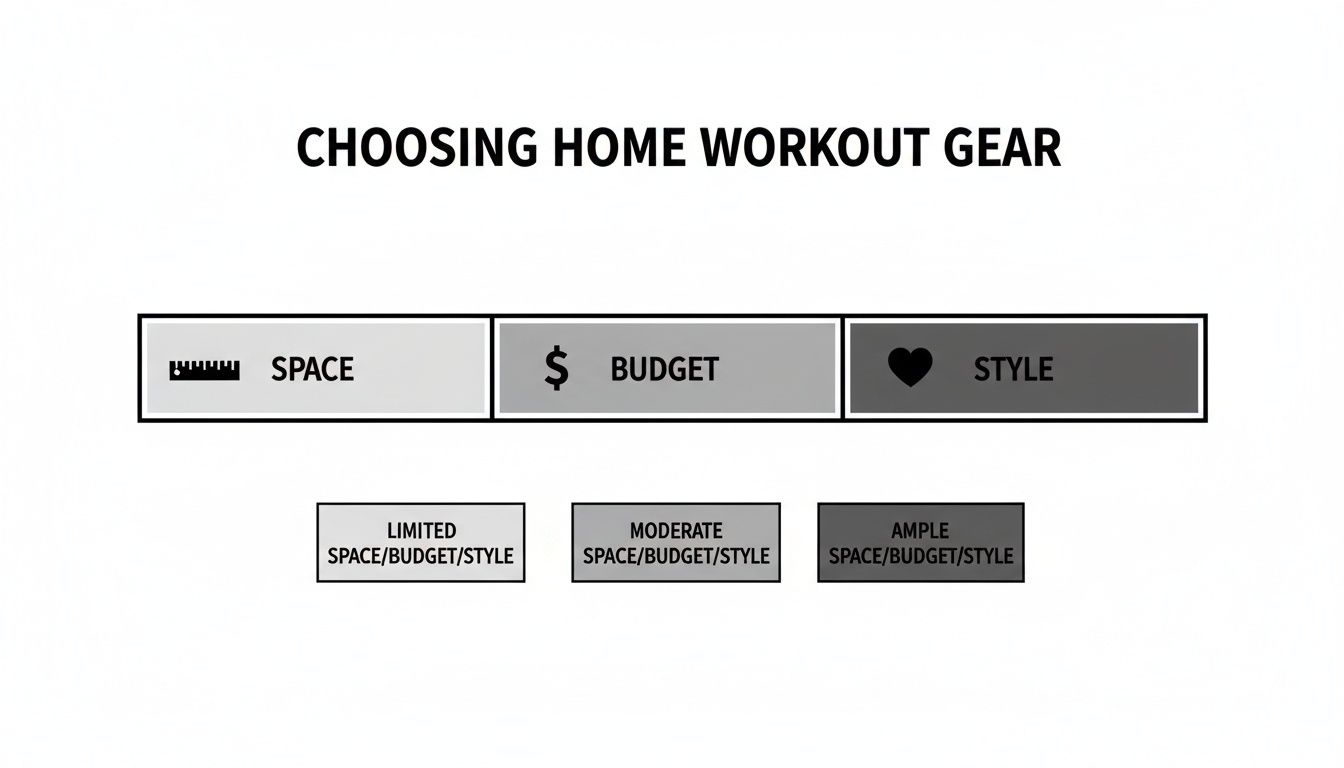
Use this as a quick visual guide to narrow down your options before you dive into the specifics of each machine.
Comparing Cardio Machines for Maximum Calorie Burn
To really see how these machines stack up for weight loss, a side-by-side comparison is incredibly helpful. This table highlights the key differences in calorie burn, impact, and muscle engagement so you can quickly see which one aligns best with your goals.
| Equipment Type | Avg. Calorie Burn (per hour) | Impact Level | Primary Muscles Worked | Best For |
|---|---|---|---|---|
| Treadmill | 600-1200 | High | Quads, Hamstrings, Glutes, Calves | High-intensity running, incline training, and versatile cardio for all levels. |
| Elliptical | 500-800 | Low | Quads, Glutes, Hamstrings, Chest, Back, Arms | Joint-friendly, full-body workouts that are great for beginners or those with injuries. |
| Stationary Bike | 450-750 | Low | Quads, Hamstrings, Glutes, Calves | Low-impact cardio, building lower-body strength, and intense HIIT sessions. |
| Rowing Machine | 600-1000 | Low | Legs, Core, Back, Shoulders, Arms | Total-body conditioning that combines cardio with muscle-building in one workout. |
While the numbers are a great starting point, remember that the "best" machine is ultimately the one you'll use consistently.
Treadmills: The All-Weather Runner
The treadmill is a fitness classic for a reason. It gives you the power to walk, jog, or sprint your heart out, no matter what the weather is doing outside. This consistency is huge for weight loss, but its real secret weapon is versatility—specifically, the incline function.
Cranking up the incline is like forcing your body to climb a hill that never ends. It dramatically ramps up the intensity and calorie burn, firing up your glutes and hamstrings way more than running on a flat surface. This dual-action of burning fat while building lower-body muscle makes it a top-tier choice when considering the best home workout equipment for weight loss.
Ellipticals: The Joint-Friendly, Full-Body Challenger
If the pounding of running on a treadmill sounds like a nightmare for your knees and hips, the elliptical is your saving grace. It delivers a smooth, gliding motion that mimics running but without any of the harsh impact on your joints. This is a game-changer for staying consistent, because nothing kills a routine faster than joint pain.
Most ellipticals also come with moving handlebars, which turns a simple cardio session into a full-body effort. By pushing and pulling with your arms, you're lighting up muscles in your chest, back, and shoulders. This combo of upper and lower body work gets more of your body involved, pushing your heart rate higher and burning more calories in less time.
A core principle for effective weight loss is to get as many muscles working as possible. The more muscle fibers you recruit, the more energy your body has to burn, which is exactly what creates a calorie deficit.
This makes the elliptical a wonderfully efficient option for anyone looking for a comprehensive, low-impact workout.
Stationary Bikes: The Accessible Calorie Torcher
Whether it's an upright or a recumbent model, the stationary bike offers a fantastic, low-impact cardio workout that just about anyone can do. It's incredibly gentle on the joints, making it a perfect starting point for beginners or a safe bet for those recovering from an injury. But don't let the seated position fool you; a tough cycling session can absolutely torch calories.
The workout is centered on your lower body, building serious strength in your quads, hamstrings, and glutes. Strengthening these large muscle groups is a smart strategy for weight loss, as they burn a lot of calories both during and after your workout. Bikes are especially brilliant for High-Intensity Interval Training (HIIT)—alternating between all-out sprints and slower recovery periods is a proven way to maximize fat loss.
Rowing Machines: The Ultimate Hybrid Workout
Often hiding in the corner of the gym, the rowing machine is the unsung hero of weight loss equipment. It’s a unique hybrid, seamlessly blending a high-intensity cardio blast with a full-body strength workout. Every single stroke engages your legs, core, back, and arms in one powerful, fluid motion.
This level of muscle activation is almost unmatched by any other single machine. It's estimated that rowing hits 85% of your body's muscles. That kind of total-body effort leads to a massive calorie burn and stimulates muscle growth from head to toe. There's a reason the cardio equipment market is projected to command a 63% revenue share of the home gym space by 2025—machines like the rower deliver incredible results. In fact, experts suggest that with a solid diet, consistent 30-minute rowing sessions can help you lose up to 2-3 pounds a week. You can read more about the home gym equipment market trends to see just why these machines are booming in popularity.
Building Muscle to Supercharge Your Metabolism
While cardio gets all the credit for burning calories during a workout, strength training is what turns your body into a fat-burning furnace that runs 24/7. It's the real secret weapon for keeping weight off for good, and it all boils down to one simple idea: revving up your metabolism.
Think of every pound of muscle on your body as a tiny engine. Unlike fat, which just sits there, muscle is metabolically active tissue. It needs a constant supply of calories just to maintain itself, even when you’re relaxing on the couch.
So, when you build more muscle through resistance training, you're essentially upgrading your body's engine. A body with more lean mass has a higher basal metabolic rate (BMR)—the number of calories you burn just by being alive. This is precisely why making time for strength work is a non-negotiable part of any smart weight loss plan.
The Power of Compound Exercises
To get the most metabolic bang for your buck, you want to get as many muscle fibers working as possible with every single rep. That's where compound exercises come in. These are the big, multi-joint movements that work several muscle groups at once, which means they demand a ton more energy than exercises that only isolate one muscle.
For instance, a bicep curl is an isolation exercise that hits, well, your bicep. But a dumbbell row? That's a compound move that lights up your back, biceps, shoulders, and core simultaneously. The row will always be more effective for weight loss because it forces your body to do so much more work.
Here are some of the all-time best compound moves you can do at home:
- Squats: Targets your quads, glutes, hamstrings, and core.
- Deadlifts: Fires up your entire backside, from your traps down to your hamstrings.
- Overhead Press: Hits the shoulders, triceps, and the core stabilizers that keep you steady.
- Rows: The foundation for building a strong back and powerful biceps.
- Push-ups: A bodyweight powerhouse for your chest, shoulders, and triceps.
These movements are the bread and butter of efficient strength training. They turn your workout into a highly effective, calorie-torching session.
Essential Strength Training Tools for Home
You don't need a warehouse full of chrome machines to build serious muscle. A few smart pieces of the best home workout equipment for weight loss are all you need to create a powerful routine.
Dumbbells
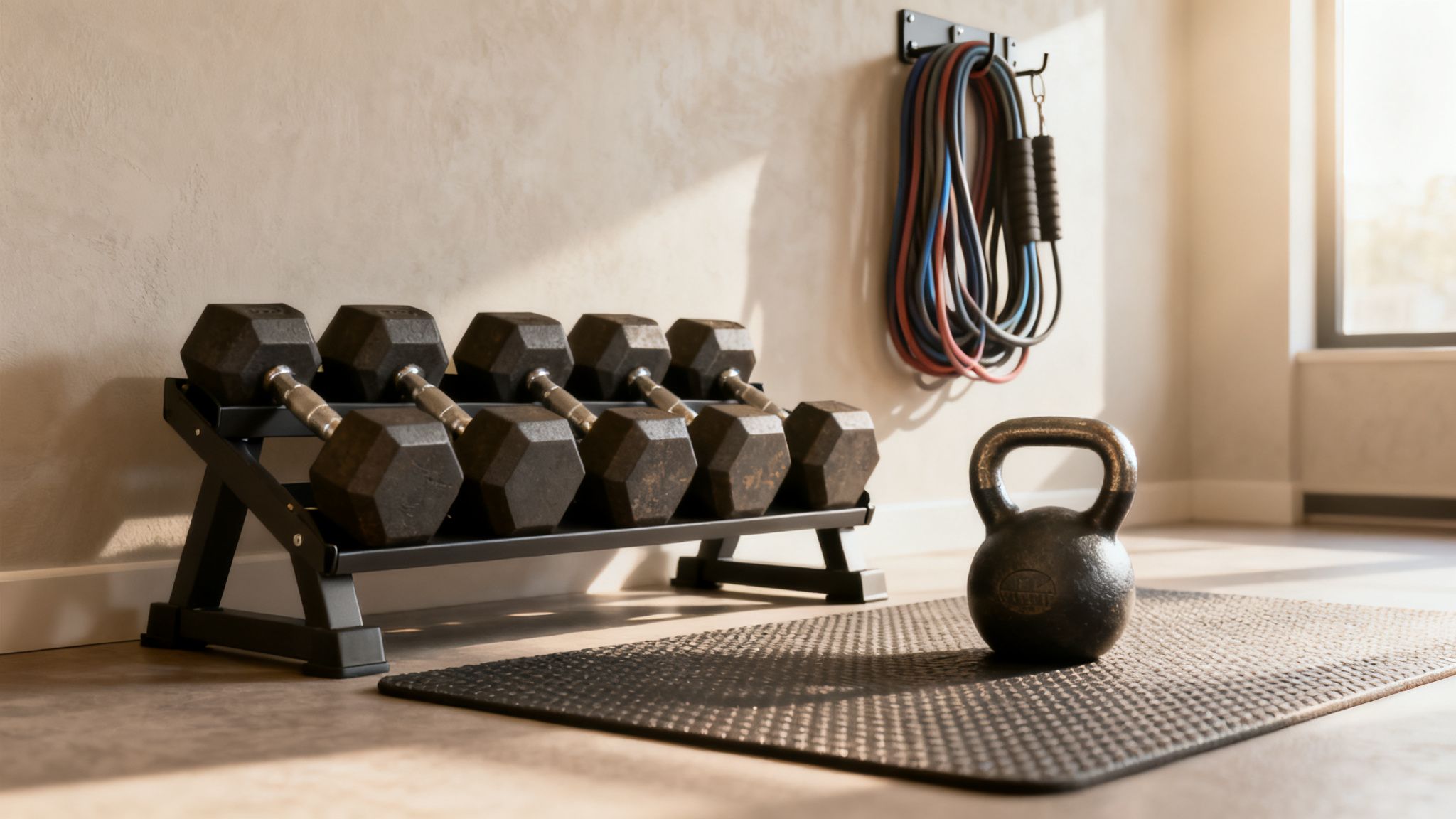
Dumbbells are the undisputed kings of home gym versatility. They unlock a massive range of exercises, from heavy compound lifts like goblet squats to smaller, more targeted movements. Because you have to control two independent weights, they also force your smaller stabilizing muscles to wake up and get involved, which improves your overall strength and balance.
If you’re tight on space, adjustable dumbbells are a brilliant investment. A single pair can replace an entire rack of traditional weights, saving a ton of room and letting you progressively add more weight as you get stronger—a crucial part of building muscle over time.
Kettlebells
The kettlebell is another fantastic tool for full-body training. Its unique design, with the weight offset from the handle, is perfect for dynamic, powerful movements like swings, snatches, and cleans. These exercises are incredible because they build strength, improve your cardio, and burn a staggering number of calories all at once.
The kettlebell swing is a perfect hybrid exercise. It builds explosive power in your glutes and hips while sending your heart rate through the roof, effectively blending a strength workout and a cardio session into one killer movement.
Even just one kettlebell can form the foundation of an incredibly tough workout. The ballistic nature of kettlebell training forces your core to work overtime, building the kind of functional strength that makes everyday activities feel easier.
Resistance Bands
Don't let their simplicity fool you; these elastic bands are seriously effective. Resistance bands are the ultimate portable, space-saving fitness tool. They provide what's called variable resistance, meaning the tension gets heavier the more you stretch the band. This creates a unique challenge for your muscles through a full range of motion.
Resistance bands are perfect for:
- Adding a challenge to bodyweight moves: Loop a band around your thighs during squats or glute bridges to feel an extra burn.
- Helping with difficult exercises: Use a heavy band to give you a boost so you can nail your first pull-up.
- Targeting smaller muscle groups: They're fantastic for warm-ups, activation drills, and physical therapy.
Bands are an affordable and versatile addition to any home gym, proving you don’t need a pile of heavy iron to build a stronger, leaner body. By working these tools into your routine just a few times a week, you’ll supercharge your metabolism and see your weight loss results accelerate.
Affordable Tools for Powerful Workouts
Building a home gym that actually gets you results doesn't mean you have to shell out thousands for bulky, high-tech machines. In fact, some of the most effective tools for shedding pounds are simple, compact, and surprisingly cheap. This is all about working smarter, not spending more. A few well-chosen items can unlock challenging workouts that truly transform your body.
These are the unsung heroes of the fitness world. They prove you don't need a huge budget to see a huge change. Let's be honest, sometimes the most basic gear offers the most bang for your buck, making it the perfect starting point for anyone putting together a gym at home.
The Jump Rope: A Calorie-Burning Champion
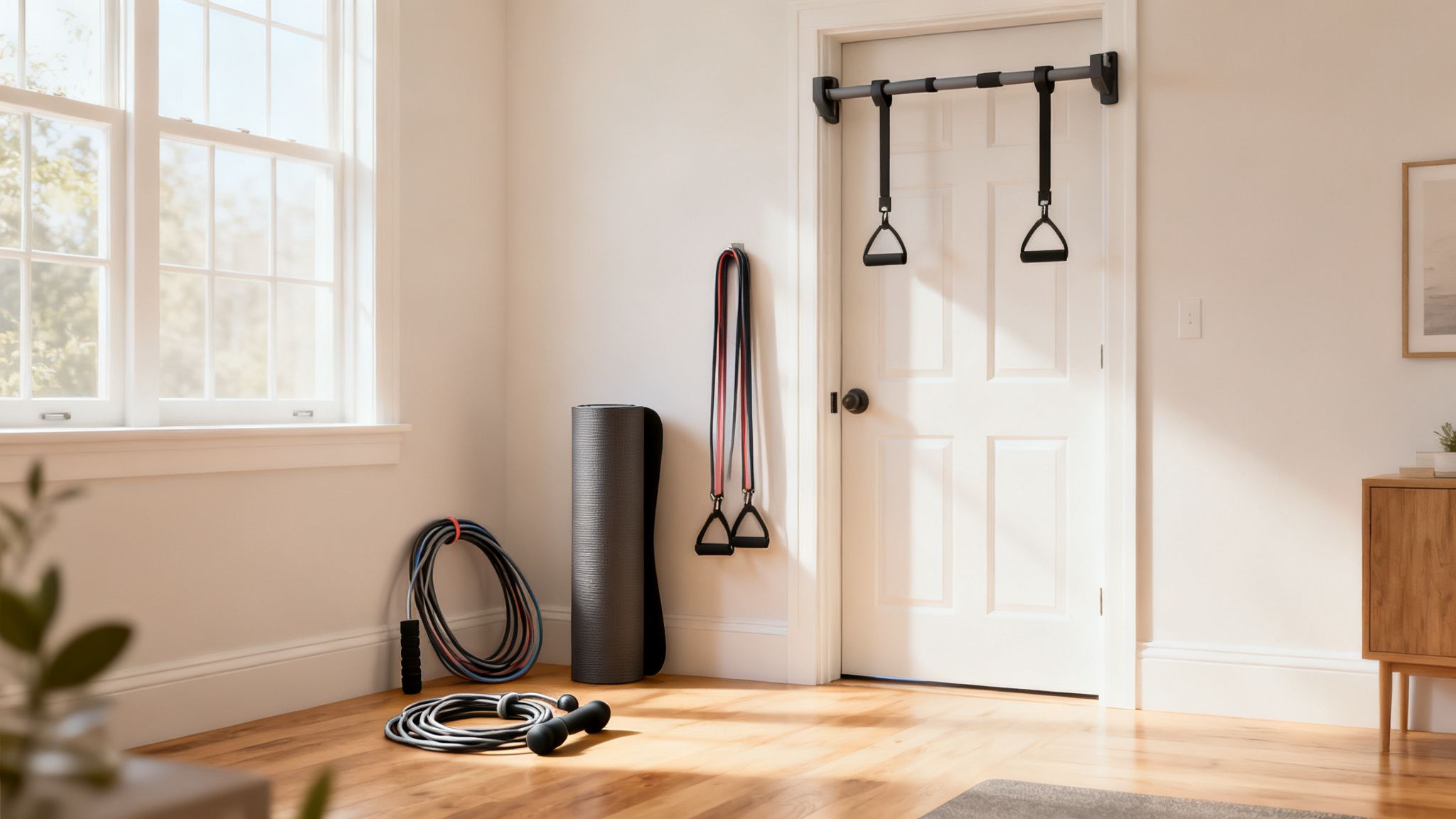
Think jump ropes are just for the playground? Think again. This simple tool is a cardio powerhouse, delivering an incredible metabolic kick. It’s one of the most efficient calorie-burners out there, torching over 10 calories per minute for an average-sized person. For some people, just 10 minutes of jumping rope can burn as many calories as a 30-minute jog.
This isn't just mindless hopping, either. It’s a full-body workout that hits everything from your calves and quads to your core and shoulders. You’re also building coordination, agility, and serious cardiovascular endurance. For something that costs less than a movie ticket and fits in a drawer, its power is hard to beat.
A simple jump rope is a perfect example of how the best home workout equipment for weight loss often prioritizes efficiency and consistency over complexity. Its portability and power make it an indispensable tool for quick, effective cardio sessions anywhere.
The Yoga Mat: Your Fitness Foundation
A good yoga mat might not feel like a piece of "equipment," but it’s the bedrock for hundreds of exercises. It gives you a stable, cushioned surface that makes floor work comfortable and safe—and when you’re comfortable, you’re more likely to stick with it. Think of your mat as the dedicated space for some of the best bodyweight exercises you can do.
Just look at the movements it makes possible:
- Planks and Push-ups: The absolute gold standard for core and upper-body strength.
- Glute Bridges: Perfect for waking up and strengthening your glutes and hamstrings.
- Crunches and Leg Raises: Classic moves for targeting your abdominal muscles.
- Stretching and Recovery: An essential part of any weight loss plan to stay injury-free and flexible.
Trying to do these on a hard floor is a recipe for bruised knees and an aching back. A mat is a small investment that opens up a massive library of movements, turning any corner of your house into a workout zone. It’s a truly essential, if often overlooked, piece of gear.
The Doorway Pull-Up Bar: Upper Body Strength, Simplified
The pull-up is the undisputed king of upper-body bodyweight exercises. A doorway pull-up bar brings this incredible movement right into your home. This clever device uses your own body weight and simple leverage to fit securely in most door frames—no screws, no damage, no fuss. You get a serious training station that takes up zero floor space.
Building a strong back and biceps is key for a balanced physique and a fired-up metabolism, and a pull-up bar is the most direct route to get there. Better yet, many models are multi-purpose. You can place them on the floor to get a deeper range of motion on push-ups or to anchor your feet for sit-ups. It’s a brilliant piece of simple engineering that delivers powerful, muscle-building results even in the smallest apartments.
How to Choose the Right Equipment for You
Alright, let's get real. Picking the right gear can feel totally overwhelming, but it doesn't have to be. The trick is to stop looking for the "best" equipment and start looking for the best equipment for you.
Think of this as a quick, honest chat with yourself. We’re going to walk through three simple questions about your budget, your space, and what you actually enjoy doing. Answering them truthfully is the key to investing in something that actually helps you lose weight, instead of just becoming a fancy new clothes rack.
Evaluate Your Budget
Money talks. Before you get lost in a sea of options, you need to decide what you're willing and able to spend. Home workout gear runs the gamut from a $10 jump rope to a $3,000+ treadmill, so setting a clear budget from the start is the quickest way to narrow things down.
Here’s a rough breakdown of what your money can get you:
- Under $100 (The Essentials): You can build a surprisingly effective toolkit here. Think resistance bands, a good quality yoga mat, a speed rope, or a single heavy kettlebell. These are perfect for getting started without a major financial commitment.
- $100 – $500 (Mid-Range Tools): This is the sweet spot for stepping things up. In this range, you'll find great adjustable dumbbells, a solid weight bench, or a decent entry-level stationary bike.
- $500+ (Premium Machines): This is where you find the high-quality treadmills, ellipticals, and rowing machines. These are serious investments, built for durability and a premium experience over the long haul.
Just remember, more expensive doesn't automatically mean better results. The best home workout equipment for weight loss is whatever you’ll use day in and day out. Consistency beats cost every single time.
Measure Your Available Space
This one is non-negotiable. Before you fall in love with a giant power rack or a sprawling elliptical, you have to face the reality of your living situation. Grab a tape measure—seriously, do it now—and figure out exactly how much floor space you can realistically dedicate to fitness.
Don’t just measure the floor! Look up. You'll need enough ceiling clearance for things like jumping rope or overhead presses with weights. Jot down the dimensions of your "workout footprint."
The good news is that manufacturers know most of us aren't living in giant mansions. Look for smart features designed for real homes:
- Foldable Designs: Many treadmills and rowers now fold up vertically, shrinking their footprint dramatically when you're done.
- Compact Models: You can find smaller, apartment-friendly ellipticals and bikes that still deliver a killer workout.
The boom in home fitness has been a game-changer. With the US home fitness market projected to hit USD 4.07 billion by 2025, companies are pouring resources into creating compact, effective gear. You can discover more insights on the home fitness market from Fortune Business Insights.
Even if you're working with a tiny corner, you have plenty of options. An entire, incredibly effective routine can be built with tools that slide under a bed or fit in a closet. For more ideas, check out our guide on exercise equipment for small spaces.
Match Equipment to Your Fitness Level and Preferences
This is it. The most important step of all. Because that top-of-the-line treadmill is completely worthless if you despise running. Being brutally honest about what you actually enjoy is the secret ingredient to sticking with it.
Ask yourself these questions:
- Where am I starting from? If you're a total beginner, jumping into a complex routine on a rower might be frustrating. A simple stationary bike or a set of light resistance bands is a much better place to start. Meet yourself where you are right now.
- Does anything hurt? If you've got bad knees or an achy back, high-impact workouts like running are a terrible idea. Low-impact machines like an elliptical or a rower will give you a great workout without punishing your joints.
- What movement feels good to me? Do you love the steady, rhythmic pace of cycling? The powerful, explosive feel of kettlebell swings? The focused, mindful flow of bodyweight yoga? Lean into whatever you find the least miserable—or even fun!
When you align your budget, your space, and your personal preferences, you've got a winning formula. You’ll end up with a setup that actually calls your name, making your weight loss journey not just something you have to do, but something you want to do.
Your Home Workout Questions Answered
Jumping into home fitness can feel like navigating a maze. It’s natural to have questions, especially when you're putting your time, money, and effort on the line for a big goal like weight loss. To help you get started with confidence, I've rounded up some of the most common questions I hear and laid out the straight-up answers.
Think of this as your personal FAQ for building a home gym that actually works. We'll get into the nitty-gritty of what you really need, how much space you have to carve out, and what kind of progress you can honestly expect.
Do I Need Both Cardio and Strength Gear to Lose Weight?
For the best, most lasting results? Absolutely, yes. Combining cardio and strength training creates a one-two punch that melts fat way more effectively than doing either one on its own. It helps to think of them as having two different, but equally important, jobs.
- Cardio is your calorie-burning engine. It’s the fastest way to torch a significant number of calories during the workout itself, which is what creates the energy deficit you need to lose weight.
- Strength training is your metabolic furnace. Building lean muscle cranks up your resting metabolism. This means your body burns more calories all day long—even when you're just sitting on the couch.
It's perfectly fine to start with just one, but weaving both into your weekly routine is the surest way to build a leaner, stronger body. This double-pronged attack ensures you're not just dropping pounds, but actually changing your body composition for good.
How Much Space Do I Realistically Need?
This is a huge hang-up for a lot of people, but you probably need less space than you imagine. The real estate required depends entirely on the gear you choose. You don't need a dedicated room to get a killer workout.
For instance, you can get a fantastic full-body session with resistance bands and a yoga mat in a space about the size of a large beach towel. On the other end of the spectrum, a treadmill might need a 3×7 foot patch of floor when you’re using it, but many new models fold up and can be tucked away in a closet, shrinking their footprint dramatically.
Before you even think about clicking "buy," grab a tape measure. Check the dimensions of your open floor space and compare them to the "in-use" dimensions of the equipment. So much modern fitness gear is designed specifically for people living in smaller spaces.
What Is the Single Best Piece of Equipment on a Budget?
There’s no magic bullet that's perfect for everyone, but we can get pretty close by focusing on your main goal. The trick is to pick the tool that you'll genuinely use week in and week out.
- For Maximum Versatility (Cardio + Strength): A heavy kettlebell or a set of adjustable dumbbells is tough to beat. They open the door to a massive range of compound exercises that build muscle and get your heart rate soaring at the same time.
- For High-Intensity Cardio in a Tiny Space: A quality jump rope. Pound for pound, it's the most cost-effective calorie-shredding tool you can own.
- For Bodyweight and Flexibility: A good yoga mat. It's the foundation for countless movements, from planks and push-ups to essential stretching and recovery work.
The "best" choice is the one that makes it easier for you to work out, not the one with the biggest price tag.
How Soon Can I Expect to See Results?
This is the big one, isn't it? The answer always comes down to two things: consistency and nutrition. Your workouts are a huge part of the equation, but what you eat is just as important. You can learn more about how to calculate a calorie deficit in our detailed guide—it's the cornerstone of weight loss.
Assuming you're sticking to a sensible nutrition plan and getting in 3-5 solid workouts per week, here’s a realistic timeline:
- Weeks 1-2: You'll feel the difference before you see it. Look for a nice boost in your energy levels, a better mood, and deeper sleep.
- Weeks 3-4: This is often when the visual changes start to kick in. Your clothes might fit a little looser, and you could see a steady 1-2 pound loss per week on the scale.
- Beyond the First Month: Don't forget to celebrate the "non-scale victories!" Being able to do more reps, lift a heavier weight, or go a few extra minutes on the treadmill are all concrete proof that you're making progress. Those performance wins are what show your body is getting stronger and healthier.
At The Happy Health Blog, our goal is to provide you with the trusted, expert-backed information you need to build a healthier life. Explore our articles for more practical tips on fitness, nutrition, and wellness. Learn more at https://thehappyhealthblog.com.
