



Losing weight really boils down to one thing: consistently eating fewer calories than your body burns. When you do this, your body has to tap into its stored energy—your body fat—to make up the difference. That's what leads to weight loss over time.
But the secret isn’t just slashing calories. The real key is finding a calorie target that’s sustainable for you and your lifestyle.
The Real Starting Point for Weight Loss
Before you even think about a calculator, let's get one thing straight. A calorie deficit is not about starvation. It's about creating a smart, manageable energy gap that still fuels your body properly. Forget the generic advice to "just eat less and move more." A successful, long-term plan starts with figuring out your body's unique energy budget.
Everything comes down to two key numbers:
- Basal Metabolic Rate (BMR): This is the baseline. Think of it as the calories your body burns just to keep the lights on—breathing, circulating blood, and keeping you warm, even if you were lying in bed all day.
- Total Daily Energy Expenditure (TDEE): This is the big one. It’s your BMR plus all the energy you use throughout the day. This includes everything from walking to your car and typing at your desk to hitting the gym and even digesting your food. Your TDEE is your maintenance level—the total calories you'd eat to stay the exact same weight.
This is why those one-size-fits-all 1,200 or 1,500-calorie diets you see online often fail. They don't take you into account—your height, weight, age, sex, or how active you are. The needs of a 5'2" office worker are worlds away from those of a 6'0" construction worker.
By calculating your own TDEE, you're not just guessing. You're setting a data-driven starting point that’s actually tailored to your body. This is the bedrock of a deficit that’s both effective and something you can actually stick with.
To make this crystal clear, I've broken down the process into three core steps. This simple framework will take you from finding your baseline needs to setting a realistic daily target.
Here’s a quick overview of what we’re about to do.
Your 3-Step Calorie Deficit Calculation
A quick summary of the core steps to determine your daily calorie target for weight loss.
| Step | What It Is | How You'll Do It |
|---|---|---|
| 1. Find Your Baseline | Calculating your BMR and TDEE to discover your unique maintenance calorie needs. | Using the Mifflin-St Jeor formula and an activity multiplier. |
| 2. Choose a Deficit | Deciding on a safe and sustainable calorie reduction from your maintenance level. | Subtracting a fixed number (e.g., 500 calories) or a percentage (e.g., 15%). |
| 3. Track and Adjust | Monitoring your progress and making changes to your plan as your body adapts. | Using tracking tools and recognizing signs that a recalculation is needed. |
Now, let's dive into each of these steps so you can get your own numbers dialed in.
Calculating Your Personal Energy Needs
Alright, let's turn the idea of a "calorie deficit" into a real number that works for you. This isn't about grabbing a generic 1,500-calorie meal plan off the internet. It's about figuring out your body's unique energy needs so you can create a deficit that's both effective and sustainable.
Our first goal is to find your maintenance calories—the amount of energy you need to stay at your current weight. Once we have that baseline, creating a smart deficit is straightforward. This whole process breaks down into two key calculations: finding your Basal Metabolic Rate (BMR) and then factoring in your daily activity to get your Total Daily Energy Expenditure (TDEE).
The journey looks like this: we start with your base metabolic rate, adjust for your lifestyle, and then subtract a moderate amount to create your deficit.
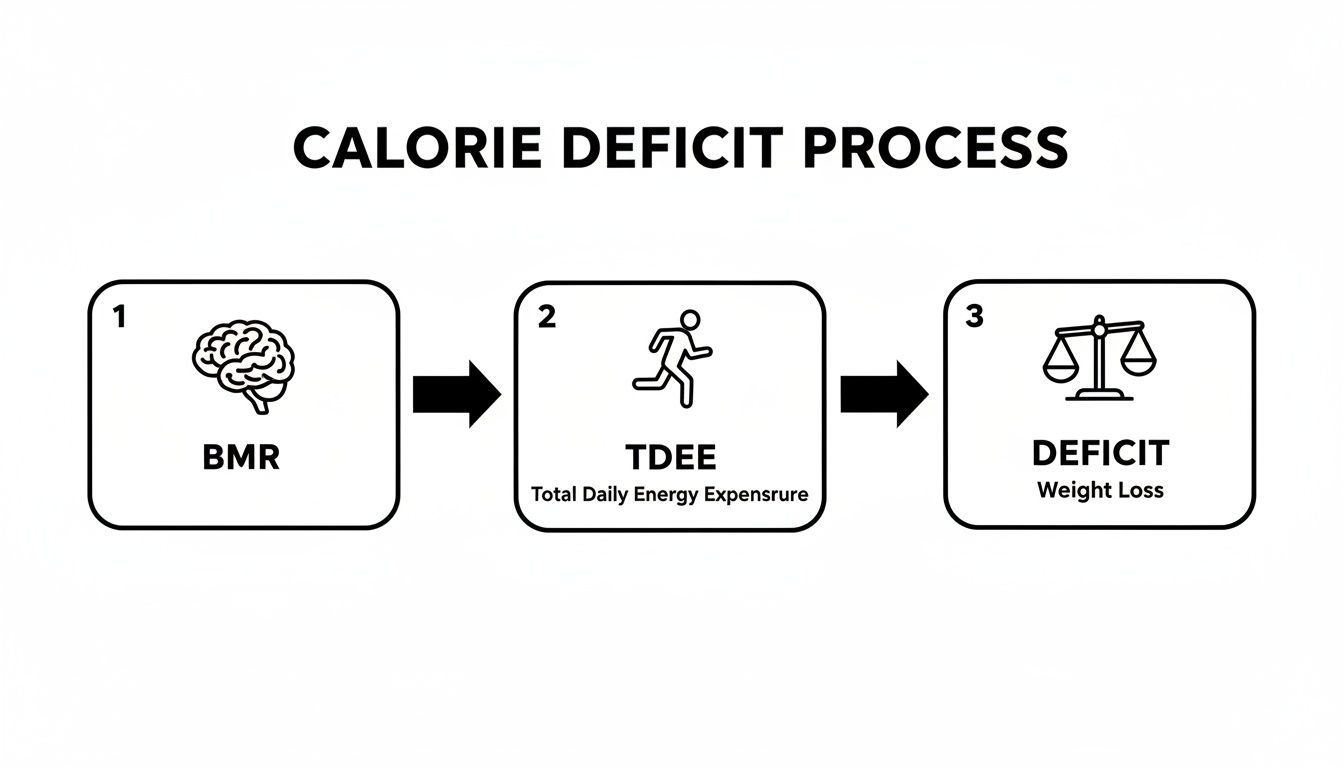
As you can see, your final calorie target is built on your personal stats, making it a reliable starting point.
Finding Your Basal Metabolic Rate (BMR)
Think of your BMR as the energy your body burns just to keep the lights on. It’s the calories you'd use for basic functions like breathing, circulating blood, and producing cells if you just rested in bed all day. It’s your metabolic “idle speed.”
For this, we'll use the Mifflin-St Jeor formula, which is widely considered one of the most reliable methods for estimating BMR.
Here's how it works:
- For Men: BMR = (10 × weight in kg) + (6.25 × height in cm) – (5 × age in years) + 5
- For Women: BMR = (10 × weight in kg) + (6.25 × height in cm) – (5 × age in years) – 161
Let's walk through an example. Meet Sarah, a 35-year-old woman who is 165 cm (about 5'5") tall and weighs 70 kg (about 154 lbs).
Her BMR calculation is:
(10 × 70) + (6.25 × 165) – (5 × 35) – 161
700 + 1031.25 – 175 – 161 = 1,395 calories.
This means Sarah’s body needs around 1,395 calories every day just to sustain itself, before she even gets out of bed. This number is our foundation.
From BMR to Total Daily Energy Expenditure (TDEE)
Your BMR is just the starting point. Nobody lies in bed all day, so we need to account for all your movement—from walking to your car to hitting the gym. This gives us your Total Daily Energy Expenditure (TDEE).
To find your TDEE, we simply multiply your BMR by an activity multiplier.
Be honest with yourself here. Choosing the right multiplier is key to getting an accurate estimate.
- Sedentary (little to no exercise): BMR × 1.2
- Perfect for someone with a desk job who doesn't work out.
- Lightly Active (light exercise 1-3 days/week): BMR × 1.375
- Fits a teacher who is on their feet but only does light workouts.
- Moderately Active (moderate exercise 3-5 days/week): BMR × 1.55
- This is a good fit for someone who works a busy job and also hits the gym consistently.
- Very Active (hard exercise 6-7 days/week): BMR × 1.725
- Think athletes or people with physically demanding jobs, like construction workers.
A little word of advice from experience: most people overestimate their activity level. It's always better to start with a slightly lower multiplier and adjust later if needed.
Back to our example, Sarah. She works in an office but goes to the gym for a mix of cardio and strength training about four times a week. That puts her squarely in the moderately active category.
So, let's calculate her TDEE:
1,395 (BMR) × 1.55 (Activity Multiplier) = 2,162 calories.
This number, 2,162 calories, is Sarah's maintenance level. If she eats this much every day, her weight should stay the same. This is the crucial baseline we need to create an effective deficit.
Now you have the most important piece of the puzzle! Knowing your TDEE takes the guesswork out of the equation and gives you a data-driven starting line. The next step is deciding how large of a deficit to create from this number. Of course, a solid plan is about more than just food. If you're new to working out, our guide on how to start exercising has some great tips to get you moving.
Choosing Your Deficit for Safe Results
You’ve done the math and now you have your TDEE—the magic number of calories your body needs just to maintain its current weight. So, what’s next? It's time to decide how big of a calorie deficit to create.
This isn't about just slashing calories randomly. The goal is to find that sweet spot that encourages consistent fat loss without making you feel tired, hungry, or miserable. It's about sustainability.
There are a couple of great ways to approach this, and the right one for you really just depends on your personal style and starting point.

The Fixed Calorie Reduction Method
This is the most straightforward route. You simply subtract a set number of calories from your TDEE every day. From my experience, a 500-calorie deficit per day is the most common and effective starting point for most people.
Why 500? It’s a well-established benchmark because it works out to roughly one pound of fat loss per week (since 3,500 calories equals about one pound). It's a moderate, manageable goal that usually won't leave you feeling overly deprived.
This approach is best for:
- Simplicity Seekers: If you like having an easy-to-remember target, this is your best bet.
- Most People: For anyone with a moderate amount of weight to lose, this method is effective and easy to stick with.
Let’s say your TDEE is 2,200 calories. A 500-calorie deficit puts your daily goal at a clean 1,700 calories. It’s simple and predictable.
The Percentage-Based Reduction Method
Another fantastic way to set your deficit is by using a percentage of your TDEE. This method feels a bit more personalized because it automatically adjusts to your body's specific energy needs. A typical starting range is a 15-20% deficit.
This can be especially helpful for people on the extreme ends of the TDEE spectrum. For example, a fixed 500-calorie cut might be too aggressive for a smaller, sedentary person with a TDEE of 1,700, but not quite enough for a large, active athlete with a TDEE of 3,500.
This approach is best for:
- Those with Higher or Lower TDEEs: It customizes the deficit to be more appropriate for your unique energy output.
- Detail-Oriented Planners: If you appreciate a more precise, tailored calculation, you'll love this method.
Using our same TDEE of 2,200 calories, a 20% deficit would be 440 calories (2200 x 0.20). This gives you a daily target of 1,760 calories. As you can see, both methods often land you in a very similar, sensible ballpark.
The Golden Rule: Safety First
No matter which method you lean towards, remember the ultimate goal is losing fat, not just weight. A deficit that’s too aggressive can cause you to lose precious muscle, create nutrient deficiencies, and even slow down your metabolism—all things that work against you in the long run.
The most important part of learning how to calculate a calorie deficit is ensuring it's safe. A sustainable plan always wins over a crash diet. Your energy levels and overall health should never be compromised.
To stay on the safe side, there are some clear minimums to keep in mind. Public health guidance often points to a moderate deficit of around 500 kcal/day for sustainable results. Crucially, experts caution against dipping below 1,200 calories for women and 1,500 for men unless you're under medical supervision. If you're curious what eating at that lower end might look like, our article on a 1500 calories a day meal plan has some great examples. Going below these levels can put your health at risk.
Putting It All Together: A Real-World Scenario
Let's bring this to life with an example. Meet David, a construction worker whose TDEE we calculated at 2,500 calories. He wants to lose weight steadily but needs enough energy to get through his physically demanding workday.
- Fixed Method: 2,500 – 500 = 2,000 calories/day.
- Percentage Method (20%): 2,500 x 0.20 = 500. So, 2,500 – 500 = 2,000 calories/day.
For David, both paths point to the same smart, sustainable target. A 2,000-calorie goal is well above the safety minimum for men and will give him plenty of fuel for his job while still promoting consistent fat loss. He can now move forward with confidence, knowing his target is both effective and responsible.
Navigating Plateaus and Metabolic Adaptation
So, you've been doing everything right. You're sticking to your calorie deficit, the weight was coming off consistently, and then… it stops. The scale just won't budge.
It’s one of the most frustrating moments in any weight loss journey, but I’m here to tell you it's completely normal. This is a classic plateau, and understanding what’s happening in your body is the first step to breaking through it.
Weight loss is almost never a straight, predictable line. Your body is a highly sophisticated machine built for survival, and when it senses a prolonged period of less energy (a calorie deficit), it starts making adjustments. It's not trying to sabotage you; it's trying to protect you.
What is Metabolic Adaptation?
This slowdown is called metabolic adaptation, sometimes referred to as adaptive thermogenesis. As you lose weight, a couple of key things start to happen under the hood.
First, your Basal Metabolic Rate (BMR) goes down. A smaller, lighter body simply requires less energy to function than a larger one. It makes sense, right? This means your total daily energy expenditure (TDEE) also decreases, even if your activity level stays the same.
Second, your body becomes more efficient. To conserve fuel, it figures out how to perform your daily activities—from your scheduled workouts to just walking up the stairs—while burning fewer calories.
The bottom line? That 500-calorie deficit you started with isn't a 500-calorie deficit anymore. It might have shrunk to just a 200-calorie deficit, or it might have become your new maintenance level. This is biology in action, not a sign that you've failed.
Why the 3,500 Calorie Rule Is a Myth
This brings us to one of the most persistent myths in the fitness world: the idea that a 3,500-calorie deficit automatically equals one pound of fat loss. While it's a handy benchmark to get started, it's a massive oversimplification that completely ignores metabolic adaptation. It treats the human body like a simple calculator, which it definitely is not.
For example, the old "3,500 kcal rule" would suggest that cutting 500 calories a day would result in losing 52 pounds in a year. But modern research using dynamic weight loss models tells a different story. As your body adapts, the actual weight loss is often much less, maybe closer to 25 pounds in that first year, with progress slowing down from there. You can learn more about the research behind dynamic weight loss models to see why.
Think of your initial calorie target as a starting point, not a permanent rule. It's a hypothesis you're meant to test and adjust based on the real-world feedback your body gives you.
Knowing this from the start helps set realistic expectations and prevents the kind of discouragement that makes people quit. The slowdown happens to everyone.
Moving Beyond the Scale
When the number on the scale gets stuck, it's easy to feel like all your hard work is for nothing. But your body weight is just one single data point, and it rarely tells the full story. This is the perfect time to shift your focus to non-scale victories (NSVs).
These are the real-life wins that prove you're making incredible progress:
- Your favorite pair of jeans fits again.
- You have the energy to play with your kids after work.
- You're lifting heavier or running faster at the gym.
- You're sleeping better and waking up refreshed.
- Climbing a flight of stairs no longer leaves you winded.
Celebrating these achievements is absolutely crucial for staying motivated for the long haul. They are tangible proof that you're getting healthier and stronger.
If you're worried that your metabolism is slowing down, especially as you get older, check out our guide on how to boost metabolism after 40 for some great strategies. By recognizing and celebrating every form of progress, you build the resilience you need to see your journey through to the end.
Tracking and Adjusting Your Plan for the Long Haul
Getting your initial calorie deficit calculated is a fantastic start, but let's be real—it's just a number. It's your best guess based on a formula. The real magic happens when you start paying attention to how your body responds and learn to make smart tweaks along the way.
Think of it this way: your calculation is the map, but how you feel and what the scale says is your compass. Now it's time to use that compass to see if you're actually heading in the right direction.

How to Actually Track What You're Eating
Tracking isn't about judging yourself; it's about gaining awareness. When you know what's going in, you have the power to change it. Luckily, there are a few tried-and-true methods.
- Calorie Tracking Apps: This is the go-to for most people. Tools like MyFitnessPal or Cronometer take the guesswork out of it. You can scan barcodes, look up restaurant meals, and see your daily totals in a snap.
- A Simple Food Journal: Don't want another app? A pen and a notebook work just as well. The simple act of writing down what you eat and drink builds an incredible intuition for portion sizes and calorie density.
The point isn't to be a slave to tracking forever. It's an educational tool. Use it for a few weeks to learn the ropes, and soon you'll be able to eyeball your portions with surprising accuracy.
Your initial calorie calculation is the starting line. Tracking your progress and adjusting your plan is how you actually finish the race.
Whichever method you pick, give it a solid 2-4 weeks of consistent effort. That's the sweet spot for gathering enough real-world data to see how your weight and energy levels are trending.
When to Recalculate Your Calorie Deficit
Here's something a lot of people miss: your calorie needs aren't static. As you lose weight, your body changes. A lighter body simply requires less energy to function, which means your TDEE will drop.
This is a good problem to have—it means you're succeeding! But it also means that the 500-calorie deficit that felt so effective at the start might now be a tiny 200-calorie deficit, or it might have vanished completely. This is the classic cause of a weight loss plateau.
So, when is it time to crunch the numbers again? Watch for these signals:
- The scale hasn't budged for 3-4 weeks. One off week is nothing to worry about. But a full month of stagnation means your body has likely adapted to your current intake.
- You've lost a significant amount of weight. I always recommend my clients recalculate after every 10-15 pounds lost. It keeps the plan accurate and effective.
- Your lifestyle has changed. Did you get a more active job? Or maybe you've seriously ramped up your gym routine? If your activity level has changed, so has your TDEE.
When you hit one of these milestones, just plug your new weight back into the Mifflin-St Jeor formula. Recalculate your BMR, then your TDEE, and apply your deficit. This simple refresh is often all it takes to get things moving again.
The Power of a Strategic "Diet Break"
Sometimes, the smartest move is to take a planned break. A diet break is a period of 1-2 weeks where you deliberately bring your calories back up to your new maintenance level. This isn't a free-for-all cheat week; it's a strategic tool.
Why do this? The benefits are both mental and physical. A diet break gives you a much-needed psychological rest from the grind of being in a deficit, boosting motivation and preventing burnout. On the biological side, it can help normalize hormones that dip during prolonged dieting, making your body more responsive when you reintroduce the deficit later.
I've found that planning a diet break after every 8-12 weeks of consistent effort works wonders. It helps turn a temporary "diet" into a sustainable, long-term approach to managing your health.
Common Questions About Calorie Deficits
Even with all the right formulas, stepping into a calorie deficit for the first time can feel a little uncertain. It's totally normal to wonder if you're doing things right or if you’ve missed a crucial detail. Let's walk through some of the most common questions and sticking points I see, so you can move forward with confidence.
Getting these details sorted out can be the difference between feeling frustrated and feeling empowered.
How Accurate Are Online Calorie Calculators?
The online calculators that use formulas like Mifflin-St Jeor are a fantastic place to start, but it's crucial to see them for what they are: a very educated estimate. They give you a solid baseline, but they can't possibly know the specifics of your genetics, hormone profile, or body composition, all of which quietly influence your real-world energy needs.
Think of the number a calculator spits out as your starting hypothesis, not a rigid prescription.
Treat your calculated calorie target as a starting line, not a finish line. The real magic happens when you use that number for a few weeks, pay close attention to how your body responds, and then make small tweaks based on what you see.
This mindset turns a static number into a dynamic, personalized tool that evolves with you.
Should I Eat Back Calories Burned from Exercise?
My professional advice? In most cases, no. Remember that activity multiplier you used to go from your BMR to your TDEE? It already accounts for the energy you spend on your typical workouts. When you start "eating back" the calories that your fitness tracker claims you burned, you're often just canceling out the deficit you worked so hard to create.
This is especially true because fitness trackers and apps are notoriously optimistic. They have a well-known habit of overestimating calories burned, sometimes by a pretty wide margin.
For consistency, it's much simpler and more effective to stick to your single calorie target. Now, if you have a ridiculously intense workout or a day of heavy physical labor, listen to your body. A small, protein-rich snack is a much smarter move than trying to perfectly match the calorie number on your watch.
Does Food Quality Matter in a Deficit?
Absolutely, one hundred percent. While the calorie deficit itself is what drives weight loss, the quality of those calories is what determines your health, your energy, and whether you can stick with it long-term. Sure, you could technically lose weight eating only junk food, but you'd feel awful and risk losing precious muscle mass along with the fat.
Think of it this way—a diet built on whole foods gives your body the toolkit it needs to thrive:
- Lean proteins are your best friend for preserving muscle, which keeps your metabolism humming.
- High-fiber foods like vegetables, fruits, and whole grains are key for feeling full and satisfied, not deprived.
- Healthy fats play a vital role in supporting your hormones and overall well-being.
Eating 1,800 calories of nutrient-dense meals feels worlds apart from eating 1,800 calories of processed snacks. Prioritizing quality makes the whole process easier and infinitely better for your body.
Why Did I Stop Losing Weight?
First off, don't panic. Hitting a weight loss plateau is an incredibly common—and frankly, expected—part of the journey. As you lose weight, your body changes. It gets smaller, and a smaller body simply needs less energy (fewer calories) to run. Your TDEE naturally goes down.
That calorie deficit that worked so well at the start might not be a deficit anymore. This isn't a sign of failure; it's a sign of success! You've changed your body. Now, it's time to adjust your plan.
Here’s how you can break through a plateau:
- Make a Small Tweak: Recalculate your TDEE using your new, lower weight. Often, dropping your target by just 100-150 calories is all it takes to get the needle moving again.
- Turn Up the Activity: You don't have to go crazy. Just add a bit more movement, like a longer daily walk or an extra gym session each week.
- Take a Diet Break: Seriously. Try eating at your new maintenance calorie level for 1-2 weeks. This can work wonders for reducing "diet fatigue" and can actually prime your metabolism for more efficient fat loss when you go back into the deficit.
At The Happy Health Blog, our mission is to give you clear, evidence-based guidance to help you take control of your well-being. For more expert tips on nutrition, fitness, and building a balanced lifestyle, explore our other articles.
