


Think a real workout is impossible just because you're short on space? I hear that all the time, but the truth is you don't need a massive room—you just need the right gear. The latest generation of exercise equipment for small spaces can turn even a tiny apartment corner into a full-blown personal gym.
Why Your Small Space Is Actually a Fitness Opportunity
Let's get one thing straight: you don't need a spare bedroom or a cavernous basement to build a great home gym. With the right equipment, any nook can become your dedicated workout zone. This guide is all about helping you create a fitness routine that works with the space you have, not against it.
Think of it like a kitchen. A cluttered countertop filled with single-use gadgets is a nightmare to cook in. But a well-organized space with a few smart, multi-purpose tools? That makes everything easier and more enjoyable. Your home gym is exactly the same. The secret isn't more square footage; it's smarter equipment that packs a punch without taking over your living room.
A Modern Take on Home Fitness
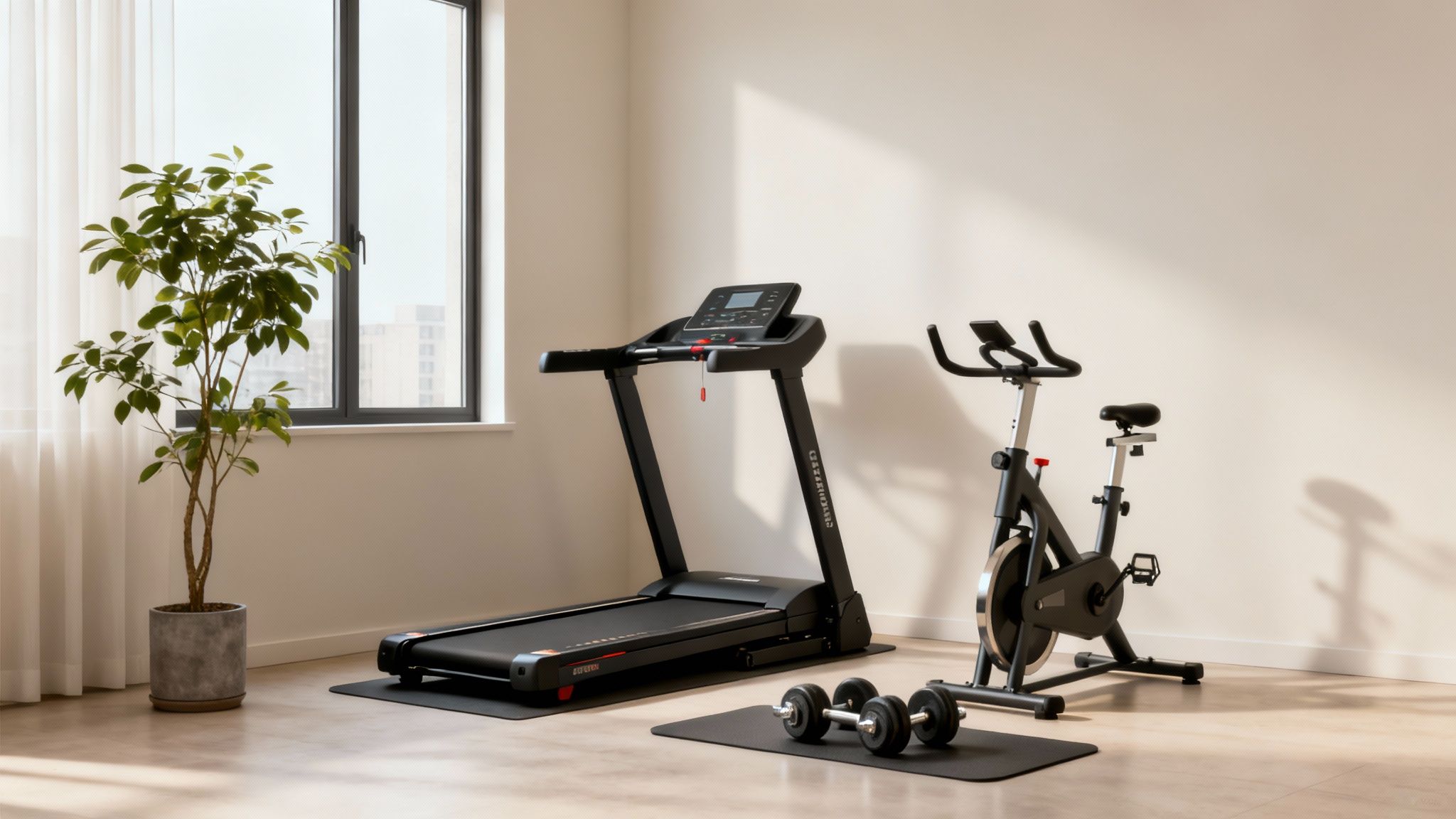
The whole world of home fitness has changed. Convenience and efficiency are what people want now, and equipment companies have come up with some brilliant designs in response. That's great news for anyone living in an apartment, condo, or shared house. You can finally build a serious routine without sacrificing your entire living area.
Of course, having the right gear is only half the battle. For those just getting started, knowing how to start exercising with a positive mindset is just as important.
This guide will walk you through the smartest choices that fit your life and your floor plan. We'll be focusing on a few key things:
- Multi-Functionality: Think equipment that does more than one job, like adjustable dumbbells that can replace an entire rack of weights.
- Portability and Storage: We're talking about gear you can easily fold up, take apart, or just slide under the bed when you're done.
- Effectiveness: These are tools proven to help you build strength, boost your cardio, and get more flexible, all without compromise.
The goal here is simple: create an inviting little workout spot that you'll actually want to use. A well-chosen piece of equipment that's always ready to go is infinitely better than a huge, intimidating machine that just ends up as a clothes hanger.
When you shift your perspective, you can turn what feels like a limitation into your greatest strength, creating a powerful and efficient home gym that fits your life perfectly.
Planning Your Perfect Workout Nook
Before you even think about clicking "buy now" on that shiny new piece of gear, let's play architect. Seriously. The single most important step is mapping out your workout territory first. It's the classic "measure twice, cut once" principle applied to fitness, and it'll save you the massive headache of realizing your dream treadmill doubles as a permanent, immovable doorstop.
The goal here isn't just to cram stuff into a corner. We want to create a space that actually pulls you in—a spot you want to use, not an obstacle course you have to navigate every day. Let's get that blueprint drawn up.
Measure Everything Twice
Alright, grab a tape measure. We need to think about your space in three different ways to make sure everything fits and you can actually use it safely.
Static Footprint: This is easy. It’s the amount of space the equipment takes up when it’s just sitting there, not in use. Think of a folded-up treadmill or a set of adjustable dumbbells tucked into their tray.
Operational Footprint: This is the one people forget, and it's critical. It’s the full amount of room you need when the equipment is in motion. A rowing machine slides back and forth, a kettlebell swing needs a clear arc, and even a simple yoga mat requires space for you to stretch your arms and legs out. You have to measure the movement, not just the machine.
Vertical Space: Don't forget to look up. Planning on skipping rope, doing pull-ups, or pressing weights overhead? Make sure your ceiling is high enough. You want to avoid punching the light fixture or knocking your knuckles. As a general rule, an 8-foot ceiling is a safe minimum for most standing exercises.
A good way to think about it is this: The static footprint is the car parked in the garage. The operational footprint is the space you need to actually open the doors, get in and out, and walk around it. Without that extra room, the car is pretty useless.
Prepare the Foundation
Once you've got your dimensions, it's time to prep the area itself. This is about more than just making it look good; it's about safety, protecting your equipment, and being a good neighbor.
Protect Your Floors: A high-quality workout mat is non-negotiable. It saves your floor from getting scratched or dented, gives your joints some much-needed cushion, and absorbs a ton of noise—an absolute must if you live in an apartment. Look for options made from high-density foam or thick rubber.
Get Your Power and Light Right: Does that elliptical need to be plugged in? Figure out your layout so you aren't creating a tripwire with an extension cord. Good lighting also makes a huge difference for mood and safety, so try to set up near a window or bring in a bright lamp.
Airflow is Key: A small room can get hot and stuffy in a hurry. Setting up near a window you can crack open is ideal. If that’s not an option, a small fan can be a game-changer, keeping you cool and making your workout way more comfortable.
Taking the time for these prep steps does more than just find a spot for your gear. It helps you design a functional, safe, and motivating environment. This little bit of planning is what turns that exercise equipment for small spaces into a seamless part of your life.
Compact Cardio Machines That Actually Fit
When you picture cardio equipment, your mind probably jumps to those massive, room-dominating treadmills and ellipticals you see at the gym. But getting your heart rate up in a small apartment doesn't mean you have to sacrifice your living room. The options for compact cardio have gotten seriously good, offering powerful workouts without the huge footprint.
These machines are built on a simple premise: work hard, then get out of the way. Think of a folding treadmill as the Murphy bed of the fitness world—it's there when you need it and neatly tucked away when you don't. This clever design means you can get in a great cardio session without your home permanently looking like a commercial gym.
Foldable Treadmills: The Space-Saving Runner
A foldable treadmill is the go-to for a reason when people start searching for exercise equipment for small spaces. They offer that classic, satisfying running or walking workout everyone knows, but with the game-changing ability to be stored vertically.
Today's folding treadmills are surprisingly robust, many with cushioned decks that are much more forgiving on your joints than pounding the pavement outside. My pro tip? Look for a model with hydraulic assistance. It makes folding and unfolding the machine a smooth, one-person job instead of a wrestling match. Just be sure to measure your intended storage spot—like that tall closet or the nook behind your bedroom door—to make sure it fits.
Stationary Bikes And Under-Desk Ellipticals
For anyone needing an ultra-quiet and low-impact workout, stationary bikes and compact ellipticals are brilliant. They’re a lifesaver for apartment dwellers worried about thumping sounds disturbing the neighbors below, or for anyone who just wants to catch up on a show while they exercise.
- Upright & Recumbent Bikes: These have an incredibly small static footprint, often taking up no more real estate than a dining chair. If you need more back support, a recumbent bike is an excellent choice, especially for older adults or those with nagging back issues.
- Under-Desk Ellipticals & Cycles: This is the ultimate in sneaky fitness. These little machines are small enough to slide right under your desk, letting you pedal away while you’re on a conference call. They won't give you the same lung-busting intensity as a full-sized machine, but they're fantastic for boosting daily activity and keeping your blood flowing.
A full-sized machine demands its own "zone" in your home. Compact cardio, on the other hand, is like a polite guest—it comes over for a great workout, then leaves your space exactly as it found it.
Portable Rowing Machines: The Full-Body Solution
Don't sleep on the rowing machine. A lot of people assume they're way too long for an apartment, but many modern rowers are specifically designed to be stored vertically. When you tip a quality rower up on its end, it can have a tiny footprint of just 2×3 feet, making it easy to slide into a corner or closet.
The real magic of a rower is its incredible efficiency. It delivers a killer cardio workout while simultaneously engaging over 85% of your muscles—we're talking legs, core, back, and arms all at once. It’s a low-impact, high-intensity workout all wrapped up in one sleek package.
This decision tree can help you visualize those first critical planning steps before you even start shopping.
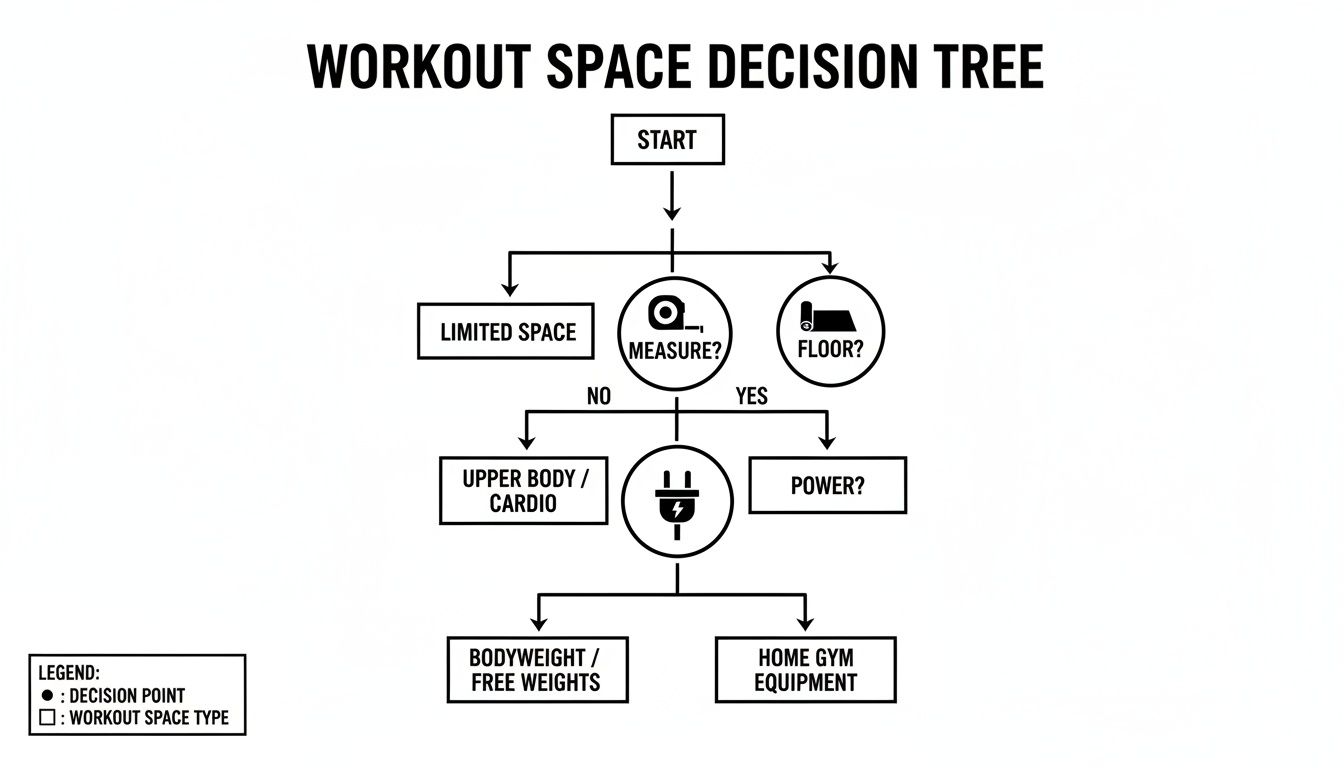
As the chart shows, simple checks like measuring your space, figuring out floor protection, and confirming you have a power outlet nearby are the foundation for a successful home gym setup.
Choosing the right machine really comes down to balancing how you like to work out with the space you actually have. This table breaks down the key differences to help you decide.
Comparing Compact Cardio Equipment
Here's a quick side-by-side look at the most popular options, focusing on what matters most in a small home: their footprint, workout type, and who they’re really for.
| Equipment Type | Average Stored Footprint | Primary Workout Focus | Best Suited For |
|---|---|---|---|
| Foldable Treadmill | 3 ft x 2.5 ft (vertical) | Running, walking, incline training | Runners who need a traditional cardio experience but are short on floor space. |
| Stationary Bike | 2 ft x 3 ft (static) | Low-impact cardio, leg strength | Anyone needing a quiet, joint-friendly workout, especially in shared living spaces. |
| Under-Desk Elliptical | 1.5 ft x 2 ft (static) | Increasing daily activity, circulation | Professionals who want to stay active while working or watching TV. |
| Vertical Storage Rower | 2 ft x 3 ft (vertical) | Full-body cardio and strength | Individuals seeking maximum workout efficiency in a minimal footprint. |
Ultimately, the best piece of equipment is the one that fits your home and your routine so well that you'll actually use it consistently. That's how you get your heart pumping without all the clutter.
Building Strength Without a Bulky Weight Rack
Let’s bust a big fitness myth: you do not need a massive, iron-filled weight rack to build serious muscle. Real strength training is all about creating resistance, not about how much floor space you can fill with equipment. When you're working with limited square footage, the trick is to choose smart, versatile exercise equipment for small spaces that replaces bulky gear with efficient, compact alternatives.
Forget needing a dedicated room for your fitness goals. A few clever pieces of equipment can give you everything you need for a killer full-body program, and they can disappear into a closet or slide under the bed when you're done. That’s how you make consistent training a reality, no matter the size of your home.
The Power of Adjustable Dumbbells
Picture an entire rack of 15 pairs of dumbbells. Now, imagine all of that condensed into a single, compact set. That’s the magic of adjustable dumbbells. They are a true cornerstone for any space-saving gym, letting you jump from 5 pounds to over 50 pounds with a quick turn of a dial or the shift of a pin.
The design is brilliant in its simplicity. You select the weight you want, and the mechanism locks just those plates into place, leaving the rest behind in the tray. This means you can move seamlessly from one exercise to the next without a long pause.
- Heavy Lifts: Set them heavy for big compound movements like goblet squats and lunges.
- Isolation Work: Dial the weight back down in seconds for bicep curls, tricep extensions, or shoulder raises.
This incredible adaptability makes them perfect for progressive overload—the core principle of gradually increasing resistance to build muscle—all without ever needing to buy another set of weights.
Suspension Trainers: Your Portable Gym
What if your entire gym could fit into a small drawstring bag? That's not a gimmick; it's a suspension trainer. This amazing piece of gear is just two adjustable straps with handles that you can anchor to a sturdy door, a pull-up bar, or even a tree branch in your backyard.
It all works by using your own body weight and gravity as resistance. By simply changing your body's angle, you can make an exercise easier or drastically harder.
Think of it this way: The closer your body is to being parallel with the floor, the more of your own weight you're lifting. An inverted row done from a steep angle is far more challenging than one where you're standing mostly upright. This endless scalability is what makes it perfect for literally any fitness level.
From push-ups and rows to pistol squats and core pikes, a suspension trainer opens up hundreds of exercise possibilities while taking up almost no storage space.
The Dynamic Duo: Kettlebells and Resistance Bands
While adjustable dumbbells and suspension trainers are the heavy hitters, a couple of other items offer unique perks for a compact strength routine.
Kettlebells are fantastic for blending strength, cardio, and power into dynamic, flowing movements. A single kettlebell doesn't need much room, but it’s perfect for swings, cleans, and presses that fire up multiple muscle groups at once. Talk about an efficient workout.
Resistance bands are, without a doubt, the most portable and affordable option out there. These simple elastic bands can add a new challenge to bodyweight exercises, give you a boost on moves like pull-ups, and provide constant tension through a movement, which is amazing for muscle activation. Our guide to the best home gym equipment for beginners shows just how much you can do with these simple tools.
There's a good reason the market for compact fitness gear is exploding. Projections show the U.S. market hitting $1.28 billion by 2025 as more people look for space-efficient solutions. Globally, the home gym equipment market is on track to reach $19.6 billion by 2035, powered by demand for affordable, high-impact gear like adjustable dumbbells that fit right into a small apartment. You can learn more about the growth of the at-home fitness market on precedenceresearch.com.
By mixing and matching a few of these powerful tools, you can build a tough, well-rounded strength program that builds muscle, supports bone density, and fits perfectly within the walls of your home.
Creative Storage Solutions for a Clutter-Free Home
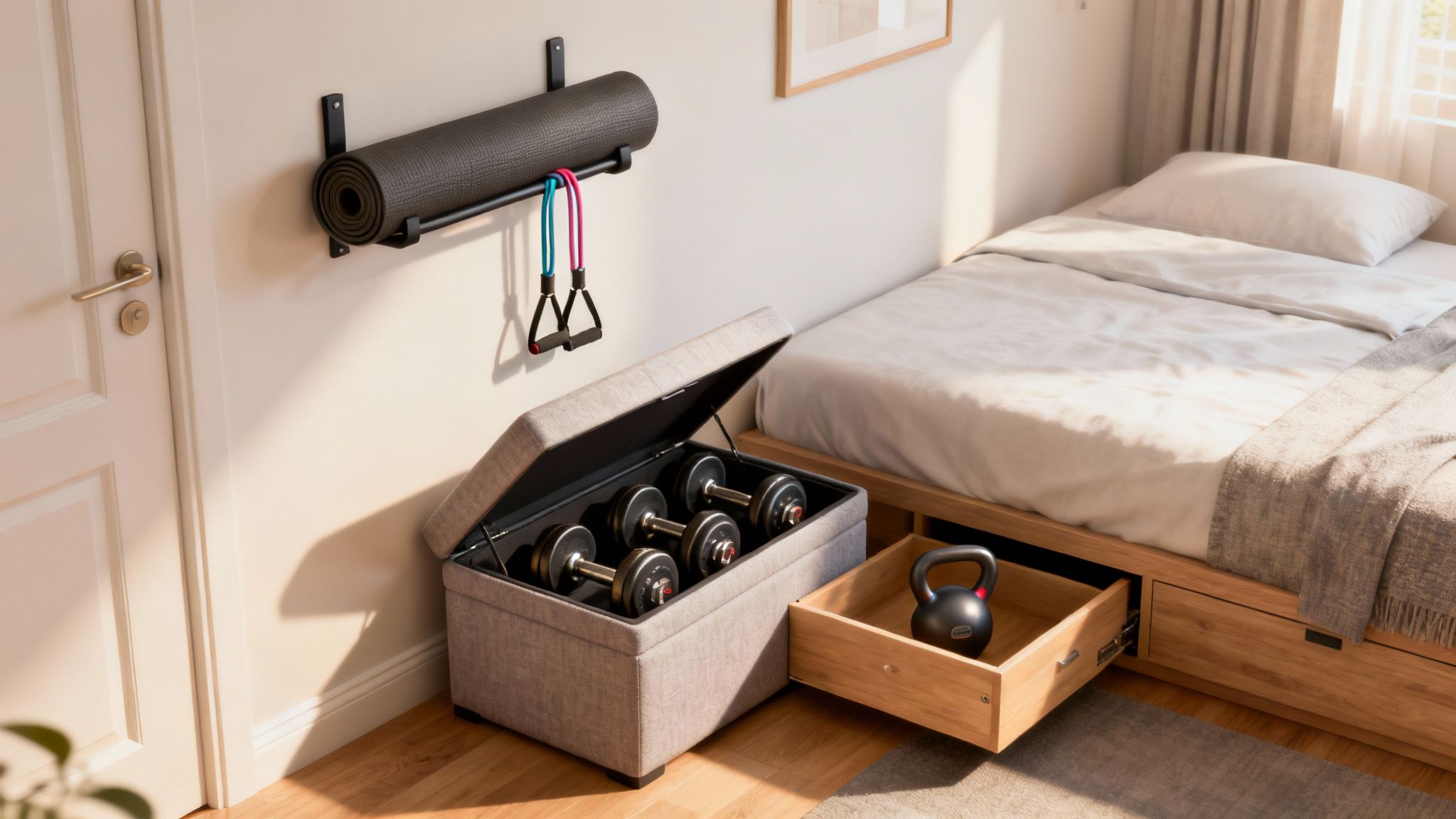
So, you’ve picked out the perfect exercise equipment for small spaces. That’s a huge win. But now comes the real challenge: keeping it from turning your apartment into a chaotic obstacle course. This is where smart storage comes in. It’s the difference between a workout corner that feels like an inspiring part of your home and one that just looks like a messy pile.
The goal here is simple. Your gear needs to be easy to grab when you're ready to sweat, and completely out of the way when you're not. This isn’t about hiding your commitment to fitness; it’s about making it fit into your life seamlessly. A well-organized space just makes it that much easier to actually do the workout.
Go Vertical to Maximize Floor Space
When you're short on square footage, looking up is your best bet. Your walls are basically a blank canvas for organization, and using them means you don't have to sacrifice precious floor space.
- Wall-Mounted Racks and Hooks: A simple pegboard or a few heavy-duty hooks are fantastic for hanging things like resistance bands, suspension trainers, and jump ropes.
- Floating Shelves: A couple of sturdy shelves can hold your foam roller, yoga blocks, and even lighter kettlebells. Just make sure they’re installed properly!
- Vertical Mat Holders: These slim, wall-mounted racks are brilliant. They keep your yoga mat rolled up, clean, and off the floor.
Uncover Hidden Storage Opportunities
Believe it or not, your home is probably full of unused storage spots. You just have to know where to look. These are the little nooks and crannies that are perfect for stashing away your more compact equipment.
Think about the space under your bed. Low-profile containers on wheels are perfect for sliding a set of adjustable dumbbells or weight plates out of sight. That gap behind the sofa? It could be the perfect home for a folded exercise bike.
The best storage solutions don't just hide your equipment; they protect it. Keeping gear in designated containers prevents dust buildup and accidental damage, extending its lifespan and ensuring it's always ready for your next workout.
Invest in Multi-Purpose Furniture
Now for the really clever part: hiding your fitness gear in plain sight. Multi-purpose furniture is the ultimate secret weapon. It pulls double duty, serving its main function while secretly housing your workout equipment.
Here are a few ideas to get you started:
- Storage Ottomans: The classic choice. Lift the lid, and you’ve got the perfect spot for kettlebells, bands, and other small accessories.
- Decorative Bins and Baskets: A nice woven basket sitting in the corner can easily hold your foam roller and yoga blocks without anyone suspecting a thing.
- Entryway Benches with Storage: A bench with a lift-up top or some cubbies underneath is a great place to tuck away your workout shoes and smaller items.
By thinking this way, your living space stays a living space, not a 24/7 gym. Combining vertical tricks, hidden nooks, and sneaky furniture creates a system where everything has a home, keeping your workout zone—and your mind—clear and ready to go.
Effective Workouts for Your Compact Gym
Having the right exercise equipment for small spaces is a huge win, but the real magic happens when you actually put it to use. A great routine doesn't have to be complicated or take hours out of your day—it just needs to be consistent and smart.
These three workouts are designed to give you a powerful, balanced session using the exact kind of gear that fits neatly into your home. Think of them as your starting blueprints. Feel free to adapt them, mix them up, and tweak them based on your energy levels and goals. The most important thing is simply to move your body safely and find a rhythm that works for you.
The 20-Minute HIIT Power Session
When you're short on time, High-Intensity Interval Training (HIIT) is your best friend. The whole idea is to go all-out in short bursts, then take a quick breather. This approach torches calories like nothing else. For this routine, all you need is a jump rope and some floor space.
Complete the following circuit 4 times, taking a 60-second rest after each full round.
- Jump Rope: 60 seconds of fast, steady skipping.
- Bodyweight Squats: 45 seconds of controlled reps. Focus on great form!
- Push-Ups: 30 seconds. Drop to your knees if you need to—it’s still effective.
- Plank: Hold steady for 45 seconds.
This is my go-to workout for those super busy days when I need to get my heart rate soaring without any fuss. It’s a full-body blast that hits your cardio and builds real-world strength.
Key Takeaway: The goal of HIIT isn't to last an hour. It's about pushing your limits during the work intervals. Even a tough 20-minute session delivers massive fitness benefits when you bring the intensity.
Full-Body Strength Circuit
This 30-minute circuit is where your adjustable dumbbells and resistance bands really get to shine. We'll target every major muscle group with slow, controlled movements designed to build genuine strength.
Perform 3 sets of each exercise, resting for 45 seconds between sets.
- Goblet Squats: 10-12 reps (holding one dumbbell at your chest).
- Dumbbell Bench Press: 10-12 reps (you can do this on the floor or a bench).
- Bent-Over Dumbbell Rows: 10-12 reps on each arm.
- Banded Glute Bridges: 15 reps (slip the band just above your knees).
- Bicep Curls to Overhead Press: 10 reps (a great two-in-one move!).
If you're just starting out, please begin with a lighter weight. Nailing the form first is far more important than lifting heavy. For more detailed guidance, checking out a well-planned beginner home workout routine can be a game-changer. It helps ensure you build strength safely and effectively right from the start.
Cardio and Core Burn
Let's combine the efficiency of your compact cardio machine with some targeted core work for a well-rounded, 25-minute session. This routine is fantastic for building endurance while sculpting a strong, stable midsection. Plus, it’s low-impact, which is always a bonus for your joints.
Hop on your compact rower or stationary bike to get started.
- Warm-Up: 5 minutes at a comfortable, easy pace.
- Intervals: Go for 8 rounds of 1 minute at high intensity, followed by 1 minute of easy recovery.
As soon as you finish your last interval, move straight to your mat for the core finisher. Complete 2 rounds of the following exercises with no rest between them.
- Bicycle Crunches: 30 seconds.
- Leg Raises: 30 seconds.
- Russian Twists: 30 seconds (use a light dumbbell to make it harder, or just use your body weight).
This one-two punch ensures you're not just burning calories, but also building the foundational core strength that helps with posture and injury prevention. These routines prove you have everything you need to hit your fitness goals in your own small, mighty gym.
Your Compact Gym Questions, Answered
Jumping into building a home gym, especially when you're short on space, brings up a lot of questions. It's a real investment of money and floor space, so it's smart to have doubts. "How much will this actually cost?" "Are these folding machines any good?" "If I can only buy one thing, what should it be?" These are the exact questions we're going to tackle right now.
Think of this as the final check-in before you pull the trigger. Getting these details sorted will help you choose gear that fits your room, your goals, and your wallet perfectly.
How Much Should I Budget for a Small Space Gym?
You can get a killer workout without emptying your bank account. In fact, you can build a surprisingly effective setup for under $100. For that price, you could grab a quality set of resistance bands with different tensions, a good yoga mat for floor exercises, and a jump rope for a serious cardio hit. It's amazing how many exercises you can do with just those three things.
If you've got a bit more to invest, a budget between $300 and $800 opens up a whole new world. This is where you can start looking at a cornerstone piece of equipment, like a great pair of adjustable dumbbells or a solid foldable treadmill. The trick is to spend your money on the gear that does the most things first.
Are Foldable Machines as Good as Regular Ones?
This is probably the most common worry I hear, and the short answer is: yes, for home use, they absolutely are. The hulking machines at your local gym are built to take a beating from dozens of people, all day, every day. The equipment designed for your living room doesn't need that level of over-engineering. Today's models are more than tough enough for you and your family.
So, how can you spot a good one? Look for a few tell-tale signs of quality:
- High User Weight Capacity: This is a great indicator of a strong, well-made frame.
- Solid Steel Construction: You want steel, not flimsy plastics or cheap alloys holding you up.
- Positive User Reviews: Pay attention when people talk about how "stable" or "sturdy" it feels in action. A well-built foldable machine will feel secure, not wobbly, when you're using it.
Here's the bottom line: A compact machine you actually use is infinitely better than a commercial-grade beast that becomes a laundry rack. Modern designs deliver a fantastic workout without you having to sacrifice a whole room.
What Is the Single Most Versatile Piece of Equipment?
If you had to pick just one thing, it's a tight race between a suspension trainer (like a TRX) and a set of quality resistance bands. Both are incredible because they let you use your own bodyweight as the resistance, opening the door to hundreds of exercises. You can do rows, presses, squats, and core work, then tuck them away in a shoebox.
But if strength training is your main focus and you have a bit more to spend, adjustable dumbbells are the undisputed king. They give you the power of an entire rack of weights in a footprint smaller than a houseplant. For building muscle in a tight space, nothing else comes close.
At The Happy Health Blog, our goal is to provide clear, actionable advice to help you build a healthier life, no matter your space or budget. For more expert-backed tips on fitness, nutrition, and wellness, explore our resources at https://thehappyhealthblog.com.
