

Getting started with fitness is way easier than most people think. A solid beginner workout plan at home doesn't require fancy equipment or a pricey gym membership—it's all about mastering the basics right in your own living room. This way, you can sidestep all the usual excuses like gym fees and travel time, making it simple to build a routine that actually sticks.
Why Home Workouts Are Your Secret Weapon for Success
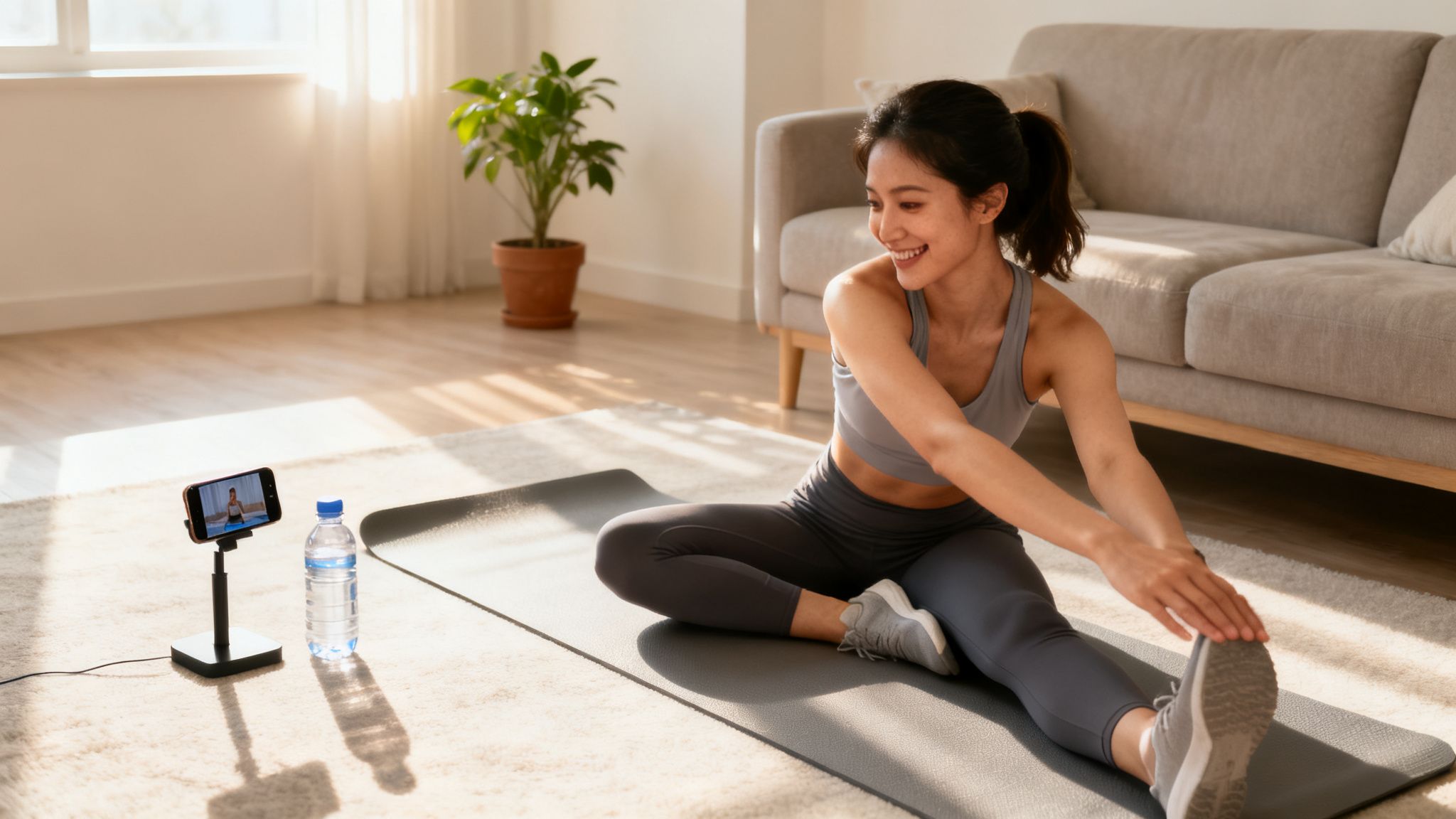
Let's be real: crowded gyms and confusing machines can be intimidating. Starting out in the comfort of your own home is genuinely one of the smartest moves you can make. It gives you a private, judgment-free space to get comfortable with the movements and build confidence at a pace that feels right for you.
This isn't just a temporary fad, either. The move towards at-home fitness is here to stay, with things like hybrid gym models and mobile exercise apps becoming incredibly popular. While the last few years certainly accelerated this shift, it's really about people wanting smart, sustainable habits that fit into their real, busy lives. You can dive deeper into the latest fitness trends to see just how mainstream home workouts have become.
The Power of Convenience and Consistency
The number one reason home workouts work? Pure convenience. No commute, no waiting for a squat rack, and no need to pack a gym bag. You’re literally removing all the little roadblocks that often derail even the best intentions.
When exercise is that accessible, consistency becomes second nature. It's much easier to squeeze in a 20-minute session before your first meeting or during a lunch break. Fitness starts to feel like a natural part of your day, not a major event you have to plan around.
The best workout plan is the one you actually stick with. By removing common obstacles like travel time and cost, home workouts set you up for long-term success from day one.
What to Expect From This 4-Week Plan
Think of this guide as more than just a list of exercises—it's your complete roadmap for the next month. We're going to focus on building a solid foundation of strength, mobility, and endurance using nothing but your own body weight.
Your 4-Week At-Home Workout Blueprint
Here’s a snapshot of your journey. This table gives you a clear roadmap of the weekly focus and progression you can expect.
| Week | Weekly Focus | Workout Duration | Key Exercises |
|---|---|---|---|
| Week 1 | Foundational Strength | 20-25 minutes | Bodyweight Squats, Wall Push-ups, Planks |
| Week 2 | Building Endurance | 25-30 minutes | Lunges, Knee Push-ups, Glute Bridges |
| Week 3 | Increasing Intensity | 30 minutes | Full Push-ups (modified), Jump Squats (optional) |
| Week 4 | Mastering Form | 30 minutes | Holding poses longer, increasing reps |
This structured approach is designed to keep you challenged without feeling overwhelmed. Each week builds on the last, so you'll be able to see and feel real progress. By the end of this plan, you won't just be stronger—you'll have the confidence and knowledge to keep your fitness journey going for the long haul.
Getting Ready For Your First At-Home Workout
A great workout routine actually starts long before you do your first squat. Think of these next few steps as your pre-launch checklist. When you get these simple but crucial details right, you're building a foundation for consistency that helps exercise feel like a natural part of your day, not a chore.
The goal here isn't to build a perfect home gym overnight. It's all about smoothing out the little bumps in the road that can kill your motivation before you even get a chance to build some momentum.
Carve Out Your Workout Space
Your environment sends powerful signals to your brain. Setting aside a specific spot for exercise, no matter how small, acts as a mental trigger that says, "Okay, it's time to move." This doesn't mean you need a spare room—a small corner of your living room or bedroom can work perfectly.
The trick is to make it your own. Try these tips:
- Keep it clear: Make sure you have enough room to fully extend your arms and legs without smacking into the coffee table. A space roughly the size of a yoga mat is usually plenty.
- Make it inviting: Keep your mat, a water bottle, and any other gear right there in that spot. When you see your setup ready to go, it’s so much easier to get started.
- Minimize distractions: If you can, try to face away from the TV or that messy desk piled high with work. This small shift helps you focus on your body and the workout itself.
This dedicated area becomes more than just a spot on the floor; it’s a powerful visual cue that helps lock in your new habit.
Gather Your Gear (The Essentials and The Nice-to-Haves)
You absolutely do not need a rack of weights or a fancy machine to get a fantastic workout. For this plan, your own body is the only piece of equipment you truly need. That said, a few items can make the experience a lot more comfortable and effective.
- A Supportive Mat: This is the one piece of "gear" I really recommend getting. It cushions your joints during floor exercises like planks and keeps you from slipping around.
- Comfortable Clothing: Pick clothes that let you move freely and are made from breathable fabric. No need for expensive brands—any comfy t-shirt and shorts or leggings will do the job.
- Proper Footwear: Supportive athletic shoes are great for stability during exercises like squats and lunges. But for many bodyweight movements, going barefoot is also a fantastic option to help strengthen the muscles in your feet.
Pro Tip: Don't let a lack of equipment stop you. A soft rug or a carpeted floor can stand in for a mat if you're just starting. The most important thing is to simply begin with whatever you have available.
Set Goals That Actually Mean Something to You
Your "why" is the fuel that will get you through those days when you'd rather stay on the couch. While losing weight is a common goal, I've found that focusing on non-scale victories is way more powerful for building a habit that sticks. What you eat also plays a huge role in your energy levels, so you might want to check out our guide on what to eat before a workout for that extra boost.
Take a moment to think about what you truly want to achieve. Your first goals could be about performance, how you feel, or just being consistent.
For instance, you could aim to:
- Hold a plank for 30 seconds straight by the end of Week 2.
- Complete three workouts every week for the entire month, without skipping any.
- Feel more energetic in the afternoons instead of needing that third cup of coffee.
Goals like these are specific and measurable, giving you tangible wins to celebrate. They prove you're getting stronger and building discipline, which, trust me, is far more rewarding than just watching a number on the scale.
The Complete 4-Week Beginner Workout Plan
Alright, let's get to the good stuff—your roadmap for the next four weeks. This is where the theory ends and the action begins. We've put together a simple but effective beginner workout plan at home designed to build a solid foundation of strength, get your heart rate up, and make you feel more confident in your own skin.
Each week is designed to build on the one before it. This is a core fitness principle called progressive overload, which is just a fancy way of saying we'll slowly make things a bit more challenging so your body keeps adapting and getting stronger. No complicated equipment or confusing moves here, just you and your own body weight.
Before you dive in, remember one crucial thing: consistency beats intensity. Every single time. It's so much better to get three solid workouts done in a week than to go all-out once and be too sore to move for days. Listen to your body, focus on doing the movements correctly, and prepare to be impressed with what you can accomplish.
How Your Weeks Will Look
To keep you on track without overwhelming you, we're sticking to a simple weekly structure. You'll have three full-body workout days with "active recovery" and rest days sprinkled in between. This approach is key for letting your muscles repair and grow, and it helps you avoid the burnout that trips up so many beginners.
Getting ready for your workout is about more than just changing clothes. It’s about setting the stage for success.
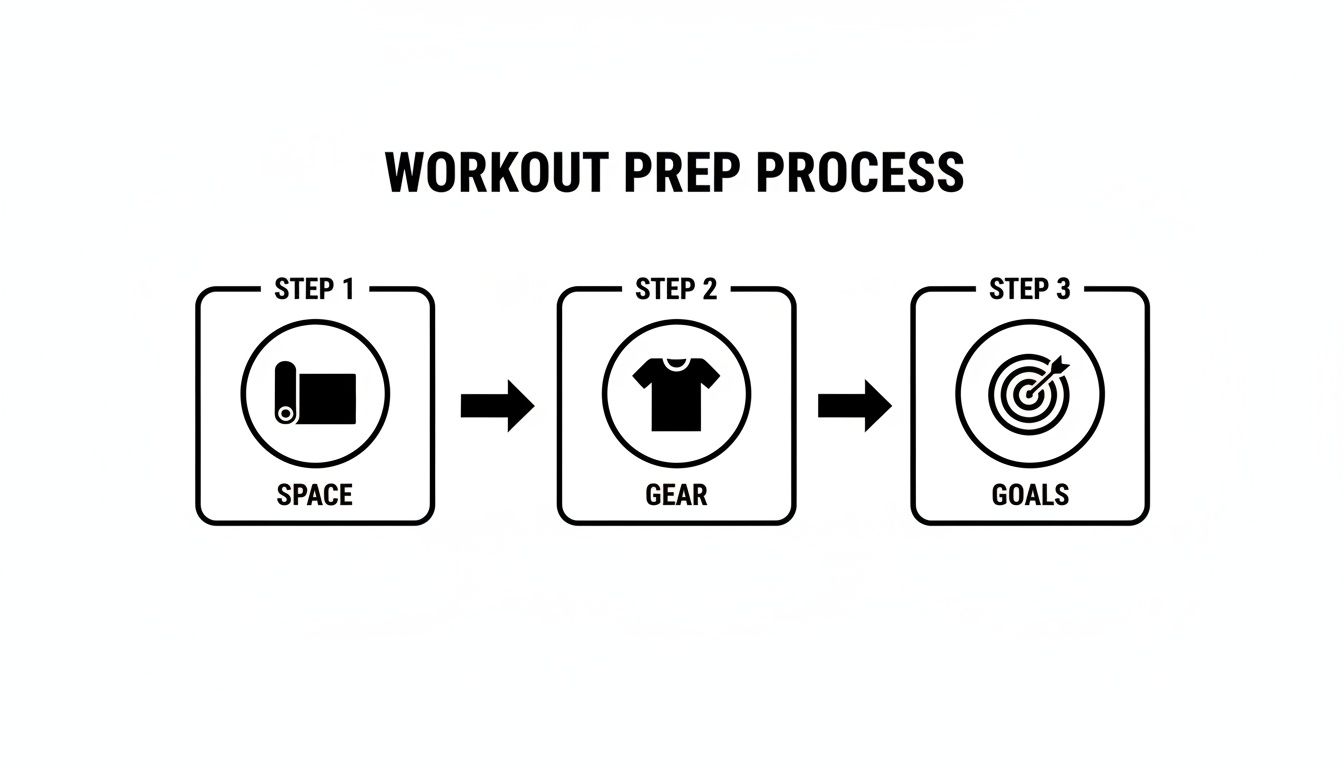
This little visual is a great reminder that a good session starts before you even do the first rep. It begins with creating your space and getting your head in the game.
Here’s a look at what a typical week could be. Don't feel locked into this exact schedule; the most important thing is to get your three workout days in with some rest in between.
Sample Weekly Workout Schedule
Use this visual calendar to see how workout days, rest days, and active recovery fit together to build strength and prevent burnout.
| Day | Monday | Tuesday | Wednesday | Thursday | Friday | Saturday | Sunday |
|---|---|---|---|---|---|---|---|
| Focus | Workout A | Active Recovery | Workout B | Active Recovery | Workout C | Active Recovery | Full Rest |
This schedule isn't just random; it's designed for results.
- Workout Days: These are your core strength sessions where the magic happens.
- Active Recovery: On these days, you'll do something light to get the blood flowing. Think a brisk 20-30 minute walk, some gentle stretching, or a casual bike ride. The goal is to move without stressing your recovering muscles.
- Full Rest: Seriously, do nothing. This is when your body does its most important repair work.
Week 1: Foundational Movements
The whole point of Week 1 is to get comfortable with the basic movements. Your only focus should be on good form. Forget about speed or cranking out a ton of reps. Slow and controlled is the name of the game.
Workout Instructions:
- Do each exercise for the number of reps listed.
- Once you’ve done all the exercises in order, that’s one circuit.
- Rest for 60–90 seconds after you finish a full circuit.
- Your goal is to complete 2–3 circuits in total.
Workout (Perform 3 Times This Week)
- Bodyweight Squats: 10–12 reps
- Wall Push-ups: 10–12 reps
- Glute Bridges: 12–15 reps
- Plank: Hold for 20–30 seconds
- Jumping Jacks: 30 seconds
Remember, every expert was once a beginner. This week is just about showing up for yourself and learning the ropes. Don't chase perfection—focus on putting in the effort.
Week 2: Building Endurance
Now that the movements feel more familiar, we're going to build up your stamina. We'll increase the challenge just a little by bumping up the reps and hold times. You should start to feel a bit stronger and more coordinated. That's progress!
Workout Instructions:
- The structure is the same, but we're aiming for a little more.
- Rest for 60 seconds after each full circuit.
- Shoot for 3 circuits total.
Workout (Perform 3 Times This Week)
- Bodyweight Squats: 12–15 reps
- Incline Push-ups (use a sofa or sturdy chair): 8–10 reps
- Reverse Lunges: 8–10 reps per leg
- Glute Bridges: 15–20 reps
- Plank: Hold for 30–45 seconds
- Jumping Jacks: 45 seconds
See that switch from Wall Push-ups to Incline Push-ups? That's a fantastic progression. By using an incline, you’re pressing more of your own body weight, making the exercise more effective at building strength.
Week 3: Increasing The Intensity
You're at the halfway point—great job! This week, we're turning up the dial. The idea is to push yourself just outside your comfort zone while keeping your form tight. You should feel pretty challenged by the end of each circuit.
Workout Instructions:
- We’re shortening the rest period just a bit to keep the intensity up.
- Rest for 45–60 seconds after each circuit.
- Complete a total of 3 circuits.
Workout (Perform 3 Times This Week)
- Bodyweight Squats: 15–20 reps
- Knee Push-ups: 6–10 reps (stick with Incline Push-ups if these are too tough)
- Reverse Lunges: 10–12 reps per leg
- Single-Leg Glute Bridges: 8–10 reps per leg
- Plank: Hold for 45–60 seconds
- High Knees: 30 seconds
We've introduced two new challenges: Knee Push-ups and Single-Leg Glute Bridges. These progressions require more stability and strength. If they feel like too much, no problem—just stick with the Week 2 versions and work your way up.
The goal isn't to master a new move on the first try. It’s about giving the harder version a shot, even if you can only do a few. That’s exactly how you get stronger.
Week 4: Mastering Consistency
This is it, the final week! It’s all about locking in your progress and appreciating how far you've come. We'll push the reps and hold times one last time, focusing on moving with confidence and control. You've spent three weeks building a fantastic habit—now let's finish strong.
Workout Instructions:
- Aim for your best performance yet, with crisp, clean form on every rep.
- Keep your rest short—only 45 seconds between circuits.
- Push for 3–4 circuits, depending on how you’re feeling.
Workout (Perform 3 Times This Week)
- Tempo Squats (3 seconds down, 1 second up): 10–12 reps
- Knee Push-ups: 8–12 reps (or try 1–2 full push-ups!)
- Forward Lunges: 10–12 reps per leg
- Single-Leg Glute Bridges: 10–12 reps per leg
- Plank with Shoulder Taps: 10 taps per side
- High Knees: 45 seconds
By adding "Tempo Squats" and "Plank with Shoulder Taps," we're challenging your muscles in new ways by increasing time-under-tension and forcing your core to stabilize. It’s a perfect example of how a simple beginner workout plan at home can evolve as you get stronger, no equipment needed.
What Comes After Week 4?
You did it! Take a moment to appreciate that you just completed a full month of consistent training. The most important thing you've built isn't just muscle; it's a habit.
So, what’s next? You’ve got some great options.
- Repeat the Plan: Go right back to Week 1 and see if you can beat your old numbers. Can you do more reps? Hold the plank longer? Maybe try a tougher push-up variation from the start?
- Increase the Difficulty: Keep the same exercises, but level them up. Try full push-ups, add a jump to your squats, or hold a heavy backpack during squats and lunges.
- Add a Fourth Workout Day: If you're feeling great and recovering well, consider adding another workout day to your weekly routine.
- Explore New Exercises: With a solid foundation, you can start swapping in new bodyweight movements to keep your routine fresh and exciting.
This plan isn't the finish line; it's the launching pad. You've proven to yourself that you can stick with a program and get results right from home. Keep that momentum going, stay curious, and don't forget to celebrate your progress along the way.
Mastering the Moves with Proper Form
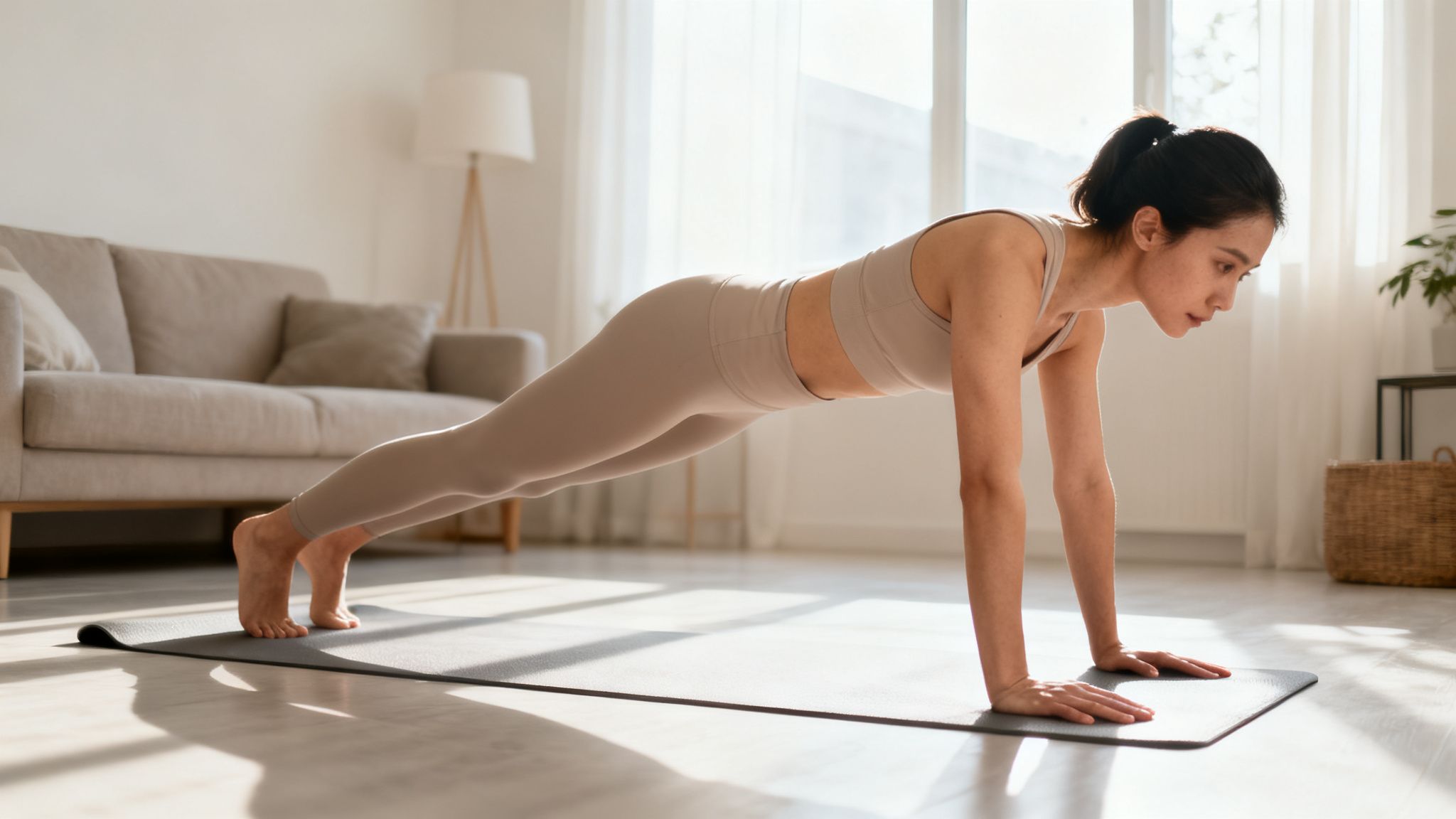
Let's talk about the single most important part of this whole plan: doing the exercises correctly. Good form is what gets you results and, more importantly, keeps you from getting hurt. This is where we’ll build the foundation for a lifetime of moving safely and effectively.
Think of it this way: one perfect repetition is so much more valuable than ten sloppy ones. We're aiming for quality over quantity, every single time.
Bodyweight Squats
The squat is a true powerhouse movement, working your entire lower body. It's also incredibly practical because it’s something you do every day—every time you sit down and stand back up.
How to Do It:
- Start with your feet just a bit wider than your hips. Your toes can point straight ahead or slightly outward, whatever feels more natural.
- Keeping your chest up and core braced, push your hips back like you're about to sit in a chair.
- Lower down until your thighs are about parallel to the floor, making sure your knees are tracking in the same direction as your toes.
- Powerfully drive through your heels to stand back up, giving your glutes a good squeeze at the top.
Common Mistakes to Avoid:
- Knees caving inward: This is a classic mistake that puts a lot of stress on the knee joints. Actively think about pushing your knees out.
- Rounding your back: Protect your lower back by keeping your chest lifted and your spine in a neutral, straight line.
Beginner Modification: If a full squat feels like too much right now, no problem. Start with chair squats. Just stand in front of a sturdy chair and practice sitting down slowly and standing back up without using your hands for support. It’s a fantastic way to build both strength and confidence.
Modified Push-Ups
Push-ups are one of the best upper-body exercises out there, hitting your chest, shoulders, and triceps all at once. If you can't do a standard one yet, don't sweat it. We'll start with variations that build you up gradually.
Remember, figuring out how to start exercising is all about taking these small, manageable steps. For a deeper dive, check out our guide on how to start exercising the right way.
Incline Push-Up (Easier):
- Find a sturdy, elevated surface—a kitchen counter, the arm of a sofa, or even a wall works perfectly. The higher the surface, the easier it will be.
- Place your hands slightly wider than your shoulders and step back so your body forms a straight line from head to heels.
- Lower your chest toward the surface, keeping your elbows tucked in at roughly a 45-degree angle, not flared out to the sides.
- Press firmly back to the starting position.
Knee Push-Up (Harder):
- Get on all fours with your hands placed a little wider than your shoulders.
- Now, walk your knees back until you have a straight line from your head down to your knees.
- Lower your chest toward the floor, maintaining that rigid line.
- Push back up with power.
Glute Bridges
This exercise is a lifesaver for waking up your glutes and hamstrings, especially if you spend a lot of time sitting. It’s also brilliant for strengthening your lower back and improving hip stability.
How to Do It:
- Lie on your back, bend your knees, and plant your feet flat on the floor about hip-width apart. Let your arms rest by your sides.
- Squeeze your core and glutes, then lift your hips up until your body forms a straight line from your shoulders to your knees.
- Hold for a second at the top, really focusing on that glute squeeze.
- Slowly lower your hips back to the floor.
Common Mistakes to Avoid:
- Over-arching your lower back: Keep your abs tight! This ensures your glutes are doing the work, not your back.
- Not lifting high enough: Concentrate on using your glutes to drive your hips up toward the ceiling.
By focusing on these key movements, you can create a really effective and balanced routine. For example, a quick 25-minute session could include a 5-minute warm-up, three sets of 10 lunges, squats, and push-ups, and finish with a 1-minute plank and a proper cool-down.
This focus on proper technique is what will turn this simple plan into a seriously effective one, setting you up for long-term success.
How to Stay Motivated and Track Your Progress
Let's be honest. Even the best at-home workout plan is useless if you don't actually do it. The real magic isn't in finding the "perfect" routine; it's in building the habits that keep you moving, especially on those days when the sofa seems to have its own gravitational pull.
A huge part of that comes down to how you measure success. It's so easy to get fixated on the number on the scale, but that rarely tells the full story and can be incredibly discouraging. Real, lasting progress is about what your body can do.
Redefine What Progress Looks Like
Instead of obsessing over your weight, I want you to start paying attention to performance and how you feel. These are the small, weekly wins that create powerful momentum and show you, without a doubt, that you’re getting stronger and healthier.
Start tracking these "non-scale victories":
- Endurance: Maybe in week one, holding a plank for 20 seconds felt impossible. By week four, you’re holding it for a full minute. That’s a massive 200% improvement!
- Strength: Remember when you could barely manage one push-up on your knees? Now you can nail five in a row with solid form. That's a huge win.
- Energy Levels: Have you noticed you’re not reaching for that 3 p.m. coffee anymore? That’s a clear sign your overall fitness is improving.
- Consistency: Did you stick to your plan and complete all three workouts this week? Celebrate that! That’s the foundation of real change.
Tracking these small victories is your secret weapon. They provide tangible proof that your hard work is paying off, which is far more motivating than waiting for the scale to move.
Seriously, grab a notebook or open a note on your phone and jot these down. When you feel your motivation slipping, read through that list. It's an instant reminder of just how far you've already come.
Navigating the Inevitable Motivation Slumps
Everyone has off days. Everyone. From total beginners to professional athletes, there are days when the motivation just isn't there. The key isn't to rely on willpower alone but to have a game plan for when that feeling strikes. If you need more ideas, we've got a bunch of fitness motivation tips in our detailed guide.
Here are a few of my favorite, battle-tested strategies:
- The 10-Minute Rule: On a day you're really dragging, just promise yourself 10 minutes. That's it. If you still want to stop after 10 minutes, you have full permission. But I'll bet that most of the time, once you get moving, you'll find the energy to finish.
- Prep Your Environment: Make it easy on your future self. Lay out your workout clothes the night before. Fill your water bottle. Make sure your workout space is clear. Removing those tiny hurdles makes getting started feel almost effortless.
- Create an Energizing Playlist: Music is a game-changer. Put together a playlist of songs that make you feel like a superhero, and save it only for your workouts. It becomes a psychological trigger to get in the zone.
- Reconnect With Your "Why": Take a quiet moment and remember why you started. Was it to have more energy for your kids? To feel strong and confident in your own skin? Keep that reason front and center.
Building a healthy relationship with fitness is about celebrating the effort, not just the outcome. By focusing on meaningful progress and having a plan for the tough days, you're not just following a plan—you're building a habit that will stick.
Got Questions About Working Out at Home?
Starting something new always comes with a few questions, and that’s a good thing! It means you're taking this seriously. Getting some clear answers right from the start will help you feel much more confident as you dive into your new beginner workout plan at home.
Let’s go through a few of the most common questions I hear from people just starting out.
How Long Until I See Results?
This is the number one question, and the real-talk answer is: it's different for everyone. But here's what you can expect—you'll probably feel a difference long before you see one. Things like having more energy during the day or sleeping more soundly can pop up in just the first week or two.
As for visible changes, like more defined muscles or a difference on the scale, you’re typically looking at 4–8 weeks of consistent work. The key word there is consistent. Don't get discouraged if you don't see massive changes overnight. Focus on the little victories, like being able to hold a plank for 10 seconds longer than last week. That's real progress.
Can I Really Get a Good Workout with Just My Bodyweight?
You absolutely can. When you're new to exercise, your own bodyweight is the perfect tool to build a solid foundation of strength. Classic moves like squats, push-ups, and lunges are powerhouses for building muscle and getting your heart rate up, no equipment needed.
The secret to making bodyweight training work is a principle called progressive overload. It just means you have to keep challenging your muscles by making the exercises a little harder over time—which is exactly how this 4-week plan is built.
What Happens If I Miss a Day?
First, don't sweat it. One missed workout isn't going to undo all your hard work. The biggest mistake people make is falling into an "all-or-nothing" trap, where they miss one session and feel like they've completely failed, so they just stop.
Life happens. Just pick right back up with your next scheduled workout. Think of fitness as a marathon, not a sprint. A single missed day is just a tiny bump in a very long road. Aim for consistency, not perfection.
Here at The Happy Health Blog, our goal is to give you the guidance and motivation you need to build healthy habits that stick. Check out all of our practical advice and take control of your well-being, one article at a time. https://thehappyhealthblog.com
