


When it comes down to it, a calorie deficit is the single most important part of the weight loss puzzle. It’s a simple concept: you just need to eat fewer calories than your body uses for energy each day. When this happens, your body has to find that missing energy somewhere, so it starts tapping into its fat stores. That’s how weight loss begins.
What a Calorie Deficit Actually Means
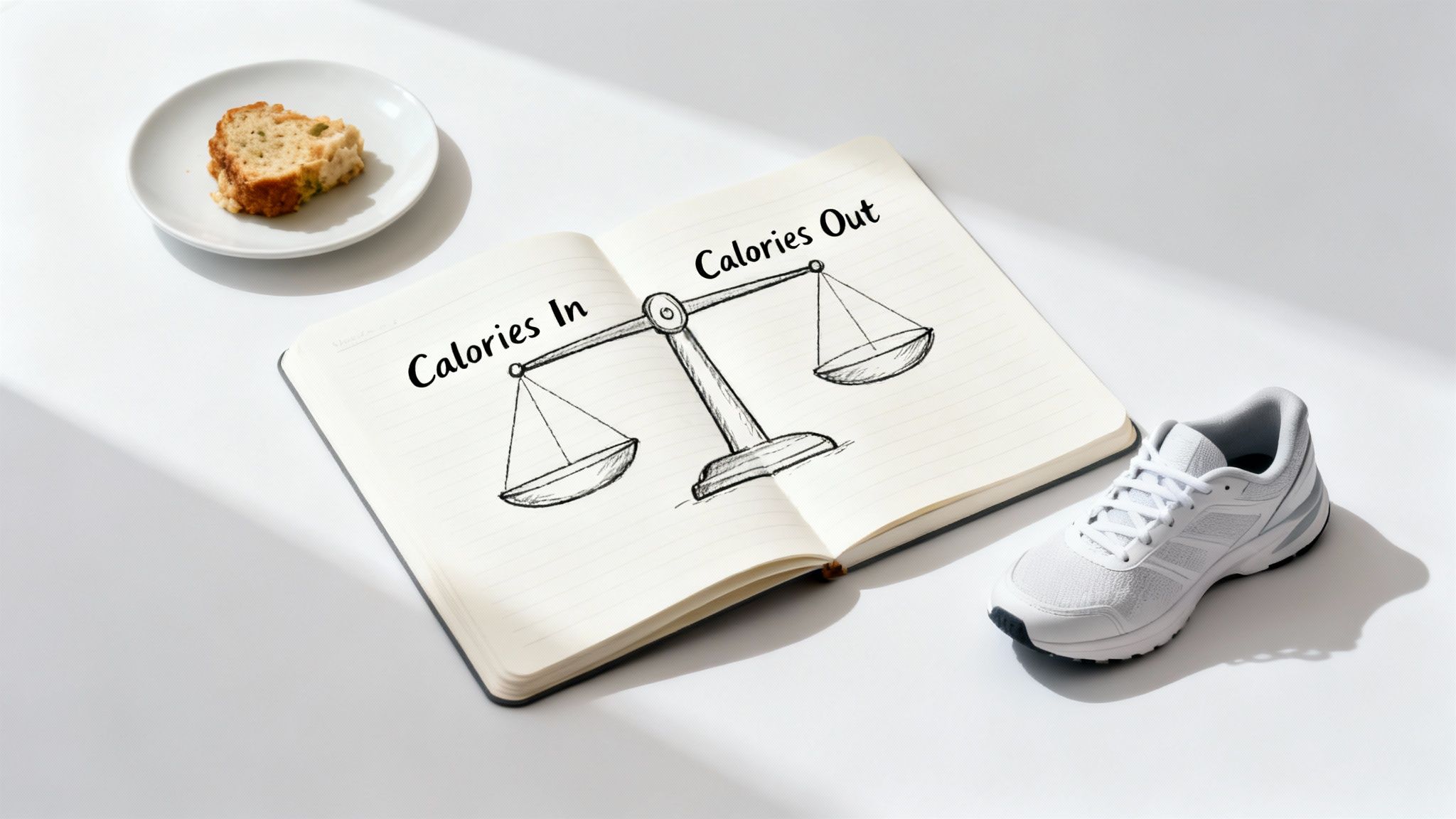
Let's try a simple analogy. Think of your body's energy like a bank account. The food and drinks you consume are your "deposits" (calories in), while all your daily activities—from breathing to running a marathon—are your "withdrawals" (calories out). To lose weight, you just need to withdraw more energy than you deposit. It’s that straightforward.
This isn't some new fad. The science behind calories and weight loss really solidified in the mid-20th century. That’s when researchers pinned down the now-famous guideline that a deficit of about 3,500 calories leads to roughly one pound of fat loss. This principle remains a cornerstone of nutrition science, and you can read more about how these discoveries influence global nutrition guidelines today.
Your Daily Energy Budget
To really get a handle on this, it helps to see your body's energy balance in three distinct states. Every day, you're in one of these three scenarios, and each one has a direct impact on your weight.
- Calorie Deficit: You’re eating fewer calories than you're burning. This is the only state where your body will lose weight.
- Calorie Maintenance: Your intake perfectly matches what you burn. This keeps your weight stable—no gains, no losses.
- Calorie Surplus: You’re eating more calories than your body can use. That extra energy gets stored, usually as fat, causing weight gain.
The big idea here is that weight management is all about this energy equation. It doesn’t matter what diet you’re on—keto, paleo, or intermittent fasting. They’re all just different strategies to help you get into, and stay in, a calorie deficit.
To make this crystal clear, the table below gives you a quick snapshot of how your daily energy balance works and what it means for you.
Your Daily Energy Balance at a Glance
This quick summary breaks down the core principles of calorie balance and how a deficit is the key to weight loss.
| Concept | What It Means for Your Body | Potential Outcome |
|---|---|---|
| Calorie Deficit | Consuming fewer calories than you burn (Energy In < Energy Out) | Weight Loss |
| Calorie Maintenance | Consuming the same calories you burn (Energy In = Energy Out) | Weight Stays the Same |
| Calorie Surplus | Consuming more calories than you burn (Energy In > Energy Out) | Weight Gain |
Understanding which state your body is in is the first step toward taking control of your weight management journey.
How Your Body Actually Burns Energy
To really get a handle on what a calorie deficit is, it helps to pop the hood and see how your body’s engine actually runs. Your body is always burning energy, 24/7, even when you're just kicking back on the couch. The total amount of energy you use up in a day is called your Total Daily Energy Expenditure, or TDEE for short.
Think of your TDEE as your personal daily energy budget. It’s the grand total of every single calorie your body burns in a 24-hour period, and it’s not just from your workout. It's a combination of everything your body does to keep you alive and moving. This number is completely unique to you—shaped by your age, gender, weight, and day-to-day lifestyle.
Getting a grip on your TDEE is the key to creating a successful calorie deficit because it tells you exactly how much fuel you're working with. Your TDEE is basically made up of three main parts, each playing its own role in how many calories you burn.
Your Basal Metabolic Rate (BMR)
The biggest piece of your energy-burning pie is your Basal Metabolic Rate (BMR). This is the bare-minimum energy your body needs to function at rest. Seriously, if you were to lie in bed all day and do absolutely nothing, your body would still be burning calories just to keep the lights on.
These essential, non-negotiable jobs include things like:
- Breathing and keeping your blood flowing
- Regulating your body temperature
- Powering your organs like your heart, brain, and kidneys
- Growing and repairing cells
Your BMR is a huge deal, accounting for a massive 60-75% of your total daily calorie burn. It’s the metabolic "rent" you pay just for being alive. Things like muscle mass play a big role here, too. The more muscle you have, the higher your BMR, because muscle tissue is more metabolically active and burns more calories at rest than fat does.
The Thermic Effect of Food (TEF)
Next up, we have the Thermic Effect of Food (TEF). This is the energy your body uses to digest, absorb, and store the nutrients from the food you eat. That’s right—you actually burn calories just by eating.
Every time you eat a meal, your digestive system has to get to work breaking it all down. This process costs energy. It’s the smallest part of your daily energy use, but it absolutely counts.
TEF usually makes up about 10% of your TDEE. What's interesting is that different foods have different effects. Protein has the highest thermic effect, meaning your body works harder (and burns more calories) to digest it compared to carbs or fats. This is one of the secret weapons behind why high-protein diets can be so effective for managing weight.
Think of it as a small, temporary metabolic boost you get every time you eat.
Energy Burn from Physical Activity
The last, and most controllable, part of your TDEE is the energy you burn from physical activity. This covers everything from a hardcore gym session to simply fidgeting in your chair. We can split this into two categories.
1. Exercise Activity Thermogenesis (EAT)
This is what most people think of as "burning calories"—the energy you use during planned, intentional workouts. This includes things like:
- Going for a jog
- Lifting weights
- Hitting a yoga class
- Swimming laps
The amount of energy you burn from EAT can change dramatically from one day to the next, depending on how you decide to move your body.
2. Non-Exercise Activity Thermogenesis (NEAT)
Here’s the unsung hero of calorie burning. NEAT is the energy you use for everything else that isn't sleeping, eating, or formal exercise. It's all the little movements you do all day long.
- Fidgeting while you work
- Walking to the mailbox
- Doing chores like vacuuming or laundry
- Taking the stairs instead of the elevator
Don’t underestimate the power of NEAT. For some people, especially those who are on their feet all day, it can add up to hundreds of extra calories burned. Bumping up your NEAT is one of the easiest, most sustainable ways to increase your daily energy burn without ever setting foot in a gym.
So, when you put it all together—your BMR, TEF, and all your physical activity (EAT + NEAT)—you get your TDEE. The whole game is to eat fewer calories than that final number. When you do, you create a calorie deficit, which is the signal your body needs to start tapping into its stored energy—your body fat—for fuel.
How To Calculate Your Personal Calorie Target
Alright, enough with the theory. Let's get practical and figure out the exact numbers you need to hit your goals. Calculating your personal calorie target is the single most important step you can take to move away from guesswork and create a plan that actually works for your body.
Instead of just grabbing a random low-calorie number off the internet (like 1,200 calories, a number that's far too low for most people), we're going to walk through a simple three-step process. First, we'll figure out your baseline metabolism, then we'll add in your daily activity, and finally, we'll subtract a small, sustainable amount to create your deficit.
Step 1: Find Your Basal Metabolic Rate (BMR)
Everything starts with your Basal Metabolic Rate (BMR). Think of this as the number of calories your body needs just to keep the lights on—powering your brain, heart, and lungs if you were to lie in bed all day.
While a lab test is the most accurate way to measure this, the Mifflin-St Jeor equation is widely recognized as the next best thing.
Here’s how it breaks down:
- For Men: (10 × weight in kg) + (6.25 × height in cm) – (5 × age in years) + 5
- For Women: (10 × weight in kg) + (6.25 × height in cm) – (5 × age in years) – 161
Let’s run through an example. Imagine Sarah, a 35-year-old woman who is 168 cm (5'6") tall and weighs 75 kg (165 lbs).
Plugging her numbers into the formula:
(10 × 75) + (6.25 × 168) – (5 × 35) – 161
750 + 1050 – 175 – 161 = 1,464 calories per day
So, Sarah's body burns about 1,464 calories daily just performing its most basic, life-sustaining functions. That's our starting point.
Step 2: Calculate Your Total Daily Energy Expenditure (TDEE)
Your BMR is just the beginning. You don't lie in bed all day, so we need to account for every bit of movement—from walking to your car to hitting the gym. This gives us your Total Daily Energy Expenditure (TDEE).
The TDEE is simply your BMR plus all the calories you burn from physical activity and even digesting food.
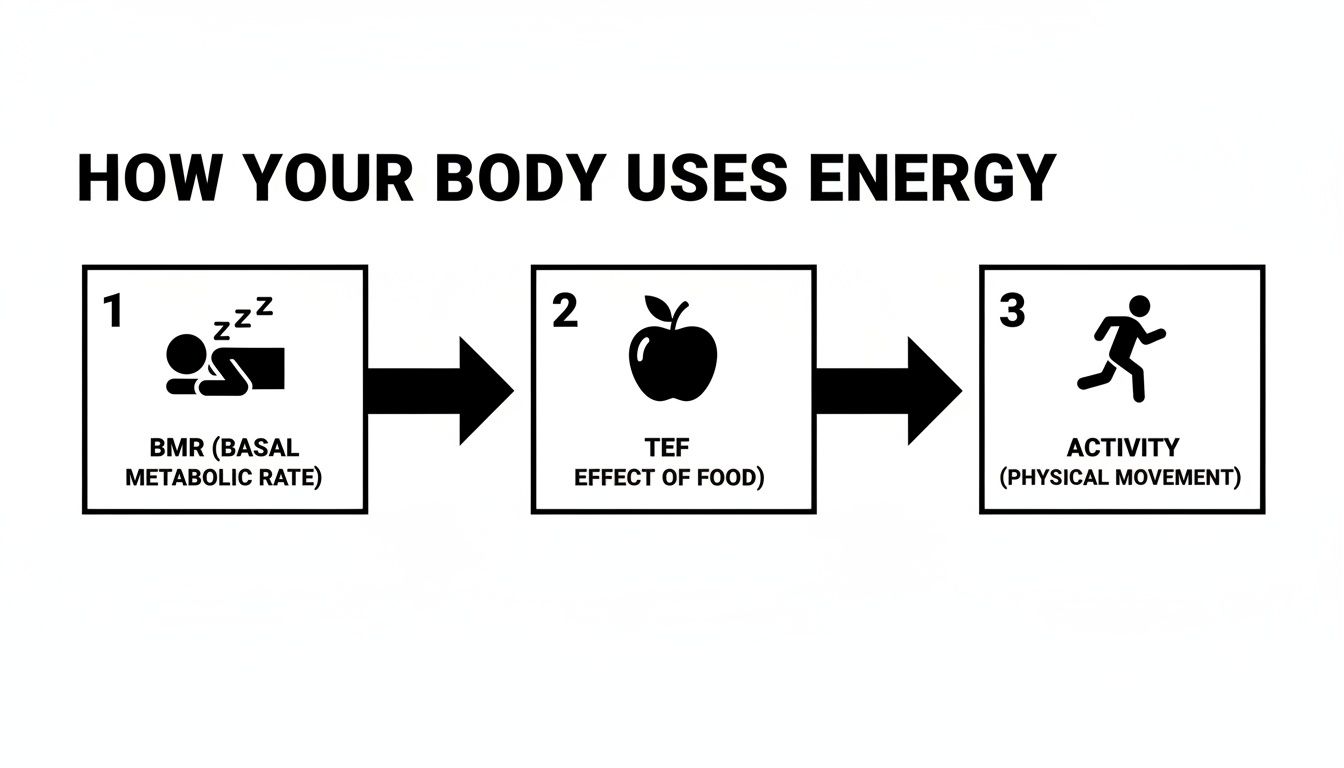
As you can see, your metabolism (BMR) makes up the lion's share of your daily burn, but activity plays a crucial role in the final number.
To find your TDEE, you'll multiply your BMR by an activity factor. First, find your lifestyle in the table below.
Activity Level Multipliers for TDEE Calculation
This table provides the standard multipliers used to estimate your total daily energy needs based on how active you are. Be honest with yourself here for the most accurate result!
| Activity Level | Description | Multiplier |
|---|---|---|
| Sedentary | Little to no exercise, desk job | 1.2 |
| Lightly Active | Light exercise or sports 1-3 days/week | 1.375 |
| Moderately Active | Moderate exercise or sports 3-5 days/week | 1.55 |
| Very Active | Hard exercise or sports 6-7 days/week | 1.725 |
| Extra Active | Very hard exercise, physical job, or training twice a day | 1.9 |
Let's check back in with Sarah. She has an office job but works out four times a week at a moderate intensity. That puts her squarely in the Moderately Active category.
So, her TDEE calculation looks like this:
BMR (1,464) × Activity Multiplier (1.55) = 2,269 calories per day
This magic number, 2,269, is what we call Sarah's maintenance calories. If she eats this much every day, her weight should stay right where it is.
Step 3: Create a Sustainable Calorie Deficit
Now for the final piece of the puzzle: creating the actual deficit. The goal here isn't to slash and burn. For sustainable, healthy weight loss, a gentle deficit of 300 to 500 calories per day is the sweet spot.
This amount is enough to trigger fat loss without sending your hunger cues into overdrive, draining your energy, or sacrificing muscle mass.
A 500-calorie daily deficit generally leads to about one pound of weight loss per week, since one pound of fat contains roughly 3,500 calories. This is a safe and realistic goal for most people.
For Sarah, creating a 500-calorie deficit is simple:
Maintenance Calories (2,269) – Deficit (500) = 1,769 calories per day
We can round that to 1,770 calories per day. That’s her target. Research consistently shows that reducing daily intake by 500-800 calories is highly effective for weight loss, especially when you prioritize nutrient-dense foods that preserve muscle.
Curious what a day of eating at a similar target might look like? Check out our guide on building a healthy 1,500 calorie meal plan.
Smart Strategies for Creating a Calorie Deficit

Knowing your target number is just the first step. The real magic happens in the choices you make every single day. Creating a calorie deficit doesn’t mean you have to overhaul your entire life, starve yourself, or say goodbye to the foods you enjoy. It’s all about making smarter, more strategic decisions with what you eat and how you move.
The idea is to find a rhythm that feels good and actually gets you results—something you can stick with. This usually means focusing on small, consistent changes that build on each other over time. By pairing mindful eating with effective exercise, you create a powerful, sustainable deficit that truly works for you.
Fuel Your Body with Nutrient-Dense Foods
Let's be clear: the quality of your calories matters just as much as the quantity. The trick is to fill your plate with nutrient-dense foods—foods that give you a huge bang for your buck with vitamins, minerals, and other good stuff, all for relatively few calories.
Think of it like this. 200 calories of broccoli is loaded with fiber and vitamins that will keep you feeling full and energized. But 200 calories of a sugary soda? That gives you virtually zero nutritional value and will probably have you reaching for another snack in an hour.
When you prioritize nutrient-dense options, you can eat satisfying, high-volume meals without blowing your calorie budget. It's the difference between feeling deprived and feeling completely nourished while you're working toward your goal.
To get started, try building your meals around these powerhouses:
- Lean Proteins: Chicken breast, fish, tofu, beans, and lentils are your best friends. Protein is incredibly satiating, which means it helps you feel full longer and naturally keeps your calorie intake in check.
- Colorful Vegetables: Load up on leafy greens, bell peppers, cucumbers, and cauliflower. They're super low in calories but packed with fiber and water, adding satisfying bulk to your meals.
- Whole Grains: Things like oats, quinoa, and brown rice provide slow-releasing energy and fiber, helping you avoid those energy crashes that lead to mindless snacking.
- Healthy Fats: Avocado, nuts, and olive oil are essential for hormone health and feeling satisfied. Just keep an eye on portion sizes, as they pack more calories per gram.
A common myth is that being in a calorie deficit means you have to be hungry all the time. The truth is, a well-planned deficit filled with protein and fiber can leave you feeling more satisfied than a higher-calorie diet of processed foods.
The Power of Protein and Simple Food Swaps
Protein is a true game-changer when you’re trying to create a calorie deficit. For one, it has the highest thermic effect of food (TEF), meaning your body actually burns more calories just digesting it compared to fats and carbs. More importantly, it helps you hold on to lean muscle while you lose weight, which is key to ensuring you’re losing fat, not muscle.
Making small, intelligent food swaps is another incredibly effective strategy. These simple changes can trim hundreds of calories from your day without you even feeling the difference. For a complete guide on this, you might be interested in our article on how to plan your weekly meals.
Here are a few easy swaps to get you started:
- Swap creamy salad dressings for a light vinaigrette or just a squeeze of lemon and some herbs.
- Choose grilled or baked chicken instead of fried.
- Replace sugary sodas and juices with sparkling water or unsweetened iced tea.
- Opt for plain Greek yogurt instead of sour cream—it's a high-protein, creamy alternative.
These little adjustments might not seem like much on their own, but when you do them consistently, they add up to a huge calorie savings by the end of the week.
Combine Cardio and Strength Training
While your diet is what truly drives a calorie deficit, exercise is the ultimate accelerator. A well-rounded fitness routine that mixes both cardiovascular exercise and strength training is the most effective way to go for fat loss and long-term metabolic health.
Cardiovascular Exercise (Cardio)
Activities like running, cycling, swimming, or even just a brisk walk are fantastic for burning calories right in the moment. They get your heart rate up and directly add to your "calories out," making it that much easier to hit your deficit. A good goal to shoot for is 150 minutes of moderate-intensity cardio each week.
Strength Training
This is your secret weapon for protecting your metabolism. Lifting weights, using resistance bands, or doing bodyweight exercises is crucial because when you're in a calorie deficit, your body can start to break down muscle along with fat. Strength training sends a powerful signal to your body to preserve that valuable, metabolically active muscle.
The more muscle you have, the higher your basal metabolic rate (BMR) is. That means you burn more calories around the clock, even when you're just sitting on the couch. This makes it so much easier to maintain your weight loss down the road.
Studies consistently show how powerful combining diet and exercise is. In one landmark study, researchers put participants on a 25% calorie deficit. One group created that deficit entirely through diet, while another split it—half from diet and half from exercise. The balanced approach didn't just lead to weight loss; it also produced major health benefits, like reducing resting metabolism by 10% and improving heart health markers. This really drives home how a two-pronged strategy delivers the best results for your body, inside and out.
Avoiding Common Calorie Deficit Traps
Starting a calorie deficit is a fantastic way to take control of your weight loss, but it's easy to make a few wrong turns that can stall your progress or even send you backward. The good news is that these mistakes are incredibly common, and once you know what they are, they're easy to fix.
Let's walk through the most frequent hurdles I see people face and how to clear them for good.
Mistake 1: Slashing Calories Way Too Low
It’s the most common trap of them all. You’re motivated and you think, "The bigger the deficit, the faster I'll lose weight!" In theory, it makes sense. In reality, your body is a lot smarter than that and will hit the emergency brake.
When you cut calories too drastically, your body doesn't just burn fat. It panics. It starts slowing down your metabolism to conserve energy, and to make matters worse, it can begin breaking down precious muscle tissue for fuel. This not only makes you feel exhausted and nutrient-deprived but also makes it harder to lose weight in the long run.
The Fix: Think sustainable, not severe. Aim for a sensible deficit of 300 to 500 calories below your daily maintenance needs. This gentle approach encourages your body to tap into fat stores for energy while preserving that hard-earned, calorie-burning muscle. Remember, this is a marathon, not a sprint.
Mistake 2: Only Counting Calories, Not Quality
Another major pitfall is getting so obsessed with the numbers that you forget what you're actually eating. Sure, a calorie is a unit of energy, but where it comes from matters immensely. 1,500 calories from processed foods, candy, and soda will leave you feeling completely different than 1,500 calories from lean protein, fibrous vegetables, and whole grains.
Focusing only on the numbers game often leads to constant hunger, low energy, and cravings that make sticking to your plan feel like a full-time job.
The Fix: Make nutrient-dense foods the foundation of your diet. Every meal should be an opportunity to fuel your body with what it needs. Prioritize lean proteins, vegetables packed with fiber, whole grains, and healthy fats. These foods don't just fill you up; they keep you satisfied, stabilize your energy, and provide the vitamins and minerals your body needs to thrive.
Mistake 3: Forgetting to Update Your Numbers
Here's something that catches a lot of people by surprise: as you lose weight, your body's energy needs change. A lighter body simply requires fewer calories to move around and function each day. This means your Total Daily Energy Expenditure (TDEE) will naturally decrease.
If you keep eating the same number of calories that worked for you at the beginning, your weight loss will inevitably slow down and you'll hit the dreaded plateau. This isn't a sign of failure—it's a sign of success!
Your calorie target isn't set in stone. It's a dynamic number that needs to adapt as your body adapts. Recalculating periodically is crucial for continued success.
The Fix: Check in and adjust your plan every so often. A good rule of thumb is to recalculate your TDEE after every 10-15 pounds of weight loss, or at least every couple of months. This quick adjustment ensures your calorie target stays effective, helping you push through plateaus and continue making steady, consistent progress toward your goal.
How to Track Progress and Stay Motivated
While hitting a calorie deficit is all about the numbers, making it last is about something more: consistency and seeing the small wins that don't always show up on the scale. To really keep yourself going, you need to look at the whole picture.
After all, the number on the scale can be a bit of a trickster. It can jump around based on anything from water retention to muscle gain, which is why it’s so important to have more than one way to measure your success.
Look Beyond the Scale
Your weight is just one piece of the puzzle—and honestly, it's not always the most interesting one. The real game-changers, the things that keep you fired up, are the non-scale victories. These are the wins that reflect genuine improvements in your day-to-day life.
Here are a few other powerful progress markers to keep an eye on:
- Progress Photos: Snap a few pictures every few weeks. They provide undeniable visual proof that your body is changing, even on days when the scale refuses to budge.
- How Your Clothes Fit: Is that pair of jeans getting a little looser around the waist? A favorite shirt fitting more comfortably? These are tangible, real-world signs you're on the right track.
- Energy Levels: Pay attention to how you feel. Do you have more gas in the tank throughout the day? That’s a huge sign your new habits are fueling your body better.
Remember, the goal isn't just about weight loss; it's about building a healthier, more vibrant life. Victories like having more stamina to play with your kids or feeling a new sense of confidence are just as meaningful as any number.
Here at The Happy Health Blog, we're big fans of a sustainable deficit—around 500 calories a day is a great target for losing about one pound per week. This steady approach is gaining ground. CDC data showed that by 2017-2018, 10% of U.S. adults were following low-calorie diets, up from 7.5% just a decade before. You can read more about these public health trends on UN News.
Staying Motivated for the Long Haul
Let's be real: motivation isn't a constant. It comes and goes. The secret is having a few tricks up your sleeve for those tougher days. It’s not about perfection; it’s about making sure one slip-up doesn’t turn into a landslide.
Having a solid support system can be a game-changer. This could be a friend you check in with, a family member who's on your side, or even an online community that gets it. Sharing your goals and your struggles keeps you accountable and gives you that extra boost when you need it most.
For more hands-on strategies, be sure to check out our guide on how to stay motivated on your fitness journey.
Got Questions About Calorie Deficits? Let's Clear Things Up.
Even when you have a great plan, questions are bound to come up. It's totally normal. Getting clear on the details of how a calorie deficit works is one of the best ways to stay motivated and on track. Let's tackle some of the most common questions I hear all the time.
Is This Calorie Deficit Going to Wreck My Metabolism?
This is probably the number one fear people have, and it’s a valid concern. The idea of "metabolic damage" from dieting is everywhere. Here’s the deal: yes, your metabolism does adapt slightly as you lose weight. Your body is smart—if you weigh less, it takes less energy to move you around.
But a serious metabolic slowdown only really happens with extreme, prolonged starvation-level diets. A sensible, moderate deficit of 300–500 calories is a different ballgame. When you pair that smart deficit with plenty of protein and regular strength training, you tell your body to burn fat for fuel while holding onto precious, metabolically active muscle. That's the secret to keeping your metabolic engine humming.
Remember, the goal isn't just to see the number on the scale go down. It's to lose fat while keeping the muscle that supports your metabolism. A moderate deficit is how you do that.
So, I Have to Be in a Deficit Forever?
Heck no. Think of a calorie deficit as a temporary tool for a specific job: fat loss. It’s not meant to be a permanent way of life.
Once you hit your goal, the job changes from losing weight to maintaining it. This is where you shift gears and find your new energy balance. You’ll slowly add calories back in—a process sometimes called "reverse dieting"—until you’re eating at your new maintenance level (TDEE). The habits you built while losing, like listening to your hunger cues and understanding portions, are the exact skills that will help you maintain your results for good without feeling like you're on a diet.
How Much Can I Really Trust These Calorie Tracking Apps?
Calorie tracking apps are incredibly useful, but they aren’t gospel. Think of them as a really good guide, not an infallible calculator. The food databases can have errors (often added by other users), and fitness trackers are notorious for overestimating how many calories you burn during a workout.
The key is to focus on the big picture, not the daily minutiae. Look at the trends over several weeks. Is the scale moving in the right direction? Do you have good energy? If so, your numbers are working for you, even if they aren't 100% precise. Use the apps to build awareness and stay consistent, not to stress over every last calorie.
Here at The Happy Health Blog, our whole mission is to give you clear, science-backed advice you can actually use. If you’re ready to feel more confident on your wellness journey, come explore more expert articles and practical tips at The Happy Health Blog.
